Wednesday, October 21, 2026
Clear, 73°Wind: mph,


Welcome to our new web site!
To give our readers a chance to experience all that our new website has to offer, we have made all content freely avaiable, through October 1, 2018.
During this time, print and digital subscribers will not need to log in to view our stories or e-editions.

Most people know the major milestones associated with retirement, including penalty-free IRA withdrawals at 59 1/2, access to Social Security benefits as early as 62, and Medicare at age 65. While age 55 doesn’t get as much attention, it also opens the door to several retirement planning opportunities, including early access to 401(k) funds (thanks to the rule of 55) and catch-up contributions in several different accounts.
If you’re approaching age 55 (or you’ve already reached it), it’s important to understand the benefits available to you. Wealth Enhancement shares five financial changes that happen at age 55 and what to consider for each one.
The typical IRS timeline lets you access your retirement dollars penalty-free at age 59 1/2, but the rule of 55 creates an exception.
What Is the Rule of 55?
The rule of 55 is an IRS provision that allows you to withdraw money from your current employer’s 401(k) or 403(b) without paying the 10% early withdrawal penalty that usually applies if you leave your job in the calendar year you turn 55 or later. If you’re a public safety employee for a state or political subdivision, the age is even lower at age 50.
An important catch is that this rule only applies to the retirement plan held by the employer you just separated from. It doesn’t extend to 401(k) or 403(b) plans from prior employers or to IRAs.
When the Rule of 55 Makes Sense
The rule of 55 makes sense in a few common situations:
Important: The rule of 55 eliminates early withdrawal penalties, but it doesn’t eliminate taxes. Unless you’re withdrawing from a Roth account, you’ll still have to pay ordinary income taxes on your withdrawals.
If you’re enrolled in a high-deductible health plan, you’re allowed to contribute to a health savings account (HSA), which offers tax-free savings for qualified medical expenses.
The Extra $1,000 You Can Contribute
Once you reach age 55, you get to contribute an additional $1,000 per year to your HSA on top of the usual limit. For 2026, that brings your total contribution from $4,400 to $5,400 for self coverage, and from $8,750 to $9,750 for family coverage.
The catch-up contribution is per person, not per account. If you and your spouse are both 55 or older, you can each contribute your own $1,000 catch-up contribution. However, it must go into an account in your own name, not a shared account.
Why HSAs Are a Powerful Retirement Tool
HSAs have an unusual triple tax advantage. Contributions go in pre-tax (or are tax-deductible), the account grows tax-free, and withdrawals are federally tax-free as long as you use them for qualified medical expenses.
Once you turn 65, HSAs become even more powerful. You can use the money for any purpose without a penalty. However, non-medical withdrawals are still taxed as ordinary income, just like your 401(k) or IRA withdrawals.
Fidelity estimates that a 65-year-old retiring in 2026 may need to spend roughly $185,500 on health care expenses in retirement, so building an HSA as soon as possible can be worthwhile.
If you’re also exploring how to maximize your 401(k) contributions, coordinating both accounts can help amplify your tax savings.
Retirement plans, including 401(k)s, 403(b)s, and IRAs, all allow catch-up contributions to help maximize your savings as you near retirement.
401(k), 403(b), and IRA Catch-Up Limits
Catch-up contributions in retirement plans actually start at age 50, so by age 55, you’ve had an extra five years to take advantage of them. If you’re checking in with your finances at 55, it’s a good time to double-check that you’ve been using them.
The 2026 catch-up contributions are:
How to Prioritize Your Catch-Up Dollars
If you can’t max out every account, a common order of priority is:
Within each account, you’ll also have to choose between traditional and Roth contributions based on your current tax bracket and where you expect to land in retirement. The table below can help:
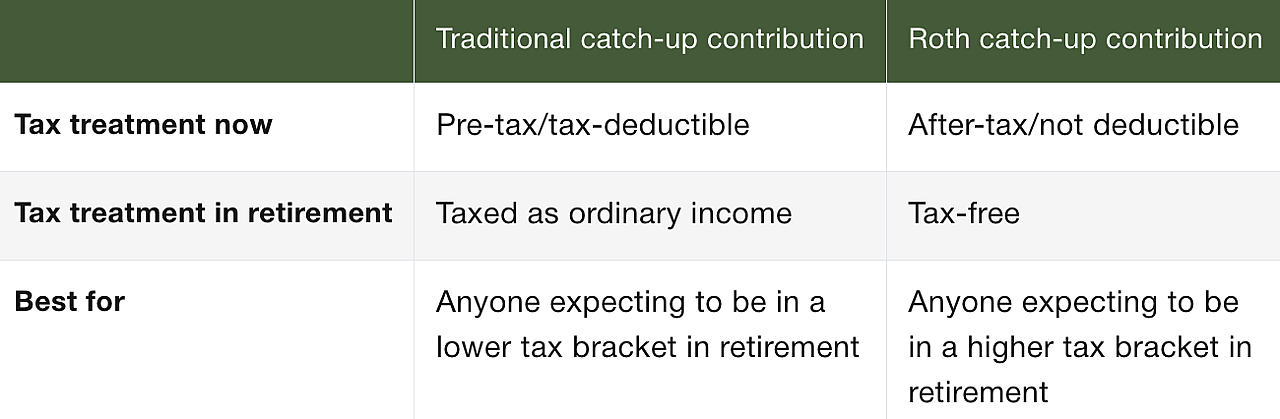
It’s important to note that, starting in 2026, anyone who earned more than $150,000 in wages the prior year must make their catch-up contributions into a Roth (i.e., after-tax) account rather than a traditional pre-tax one, assuming their plan offers a Roth option.
A Roth conversion lets you roll money from a traditional retirement account into a Roth account. You’ll pay taxes on the amount you convert and get tax-free withdrawals in retirement.
Why 55 Is a Strategic Conversion Age
If you retire at age 55, you may have several years of lower taxable income before your Social Security benefits kick in as early as age 62 and required minimum distributions (RMDs) kick in at age 75. That window can be a good time to convert traditional 401(k) or IRA dollars to a Roth account at a lower marginal tax rate.
Factors to Evaluate Before Converting
A Roth conversion isn’t right for everyone. There are a few key factors to consider:
The timing of health insurance coverage and Social Security benefits is among the largest considerations as you near retirement, and it’s critical to plan ahead.
Bridging the Gap to Medicare at 65
If you retire at age 55, you’ll have up to a decade without employer-sponsored health coverage before you’re eligible for Medicare at age 65. A few options that can help you bridge that gap include:
Budgeting for premiums, deductibles, and other out-of-pocket costs during this time is an important part of your early retirement plan. Make sure you also understand what Medicare will and won’t cover by reviewing Medicare costs and coverage basics.
Social Security Claiming Strategy Begins Now
Though you can’t claim Social Security at age 55, you can start planning for it. Now is the time to understand your options and determine which is right for you.
Keep in mind that whatever age you start collecting benefits locks in your benefit amount for the rest of your life. If you retire at 62 with the reduced benefit, you’ll get the reduced amount forever. It won’t increase when you reach age 67 or 70. Meanwhile, age 70 gives you the highest monthly benefit, but the fewest years to collect it.
Use the Social Security retirement benefits overview to estimate your projected benefit at each claiming age.
As you’re approaching retirement and reaching these milestone years, there’s a lot to consider and plan for. Here is a short checklist to help you understand everything you need to know and do:
How much money should a 55-year-old have saved for retirement?
A common benchmark suggests saving between seven and eight times your annual salary by age 55. If you earn $150,000, for example, you’d need between $1.05 million and $1.2 million. However, the right number depends on your lifestyle, living expenses, target retirement age, and other sources of income. It’s important to build a plan around your specific circumstances rather than a general rule of thumb.
Can I retire at 55 with no savings?
While it’s not impossible to retire at 55 with no savings, it’s extremely difficult. You would need to rely on the rule of 55 for any available 401(k) funds, run the numbers to maximize your Social Security benefits, keep your expenses extremely lean, and consider part-time income to help bridge the gap. Given the complexity involved, working with a financial advisor is strongly recommended if you’re considering this path.
Is $1 million enough to retire at 55?
Under normal rules of thumb, $1 million wouldn’t be enough for most people to retire at age 55. Using the commonly referenced 4% withdrawal rule, $1 million could support an annual withdrawal of roughly $40,000. However, because retiring at 55 means your savings would have to last more than 30 years, a more conservative withdrawal rate may be necessary. Ultimately, the answer depends on your annual spending, health care expenses, and other sources of income.
Turning 55 isn’t one of the most well-known retirement milestones, but it’s still one worth understanding. The rule of 55, catch-up contributions, Roth conversion window, and health care and Social Security planning horizon all represent opportunities to strengthen your retirement plan. The key is to act on them early, before your options dwindle.
This story was produced by Wealth Enhancement and reviewed and distributed by Stacker.


