Wednesday, October 21, 2026
Clear, 73°Wind: mph,


Welcome to our new web site!
To give our readers a chance to experience all that our new website has to offer, we have made all content freely avaiable, through October 1, 2018.
During this time, print and digital subscribers will not need to log in to view our stories or e-editions.

Mid-October 2026 saw the global trading landscape focus heavily on technical compliance and long-term litigation management, reports Freight Right, a freight forwarder and licensed customs broker based in Los Angeles. U.S. Customs and Border Protection launched Phase 3 of its automated CAPE portal to process remaining back-duty refunds from struck-down tariffs, even as the U.S, Court of International Trade froze pending Section 122 importer lawsuits while appellate courts review executive authority. Concurrently, cross-border supply chains operating under Washington's centralized trade architecture shifted attention to auto manufacturing, with industry leaders launching urgent campaigns in Detroit to avert a proposed 50% automotive tariff hike threatened for early 2027.
China-U.S. Ocean Freight Market:
China to U.S. ocean freight rates remain unchanged week over week as carriers extend first-half October pricing. However, space has become harder to secure following China’s National Day holiday, making booking lead times and schedule reliability more pressing concerns.
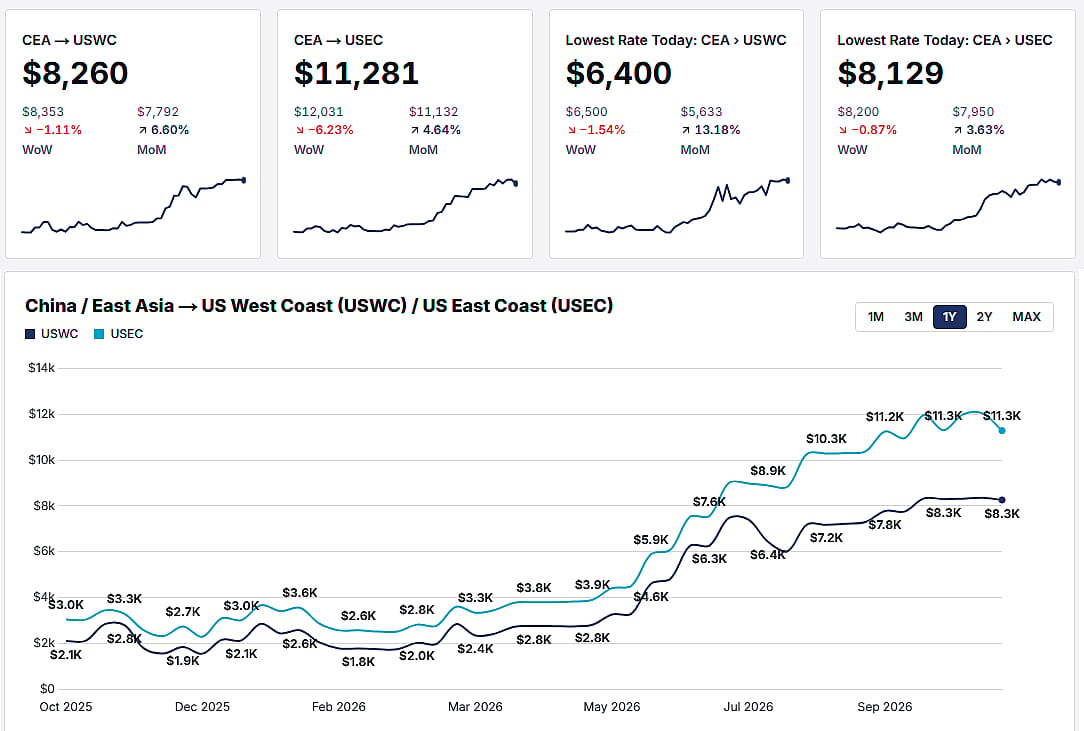
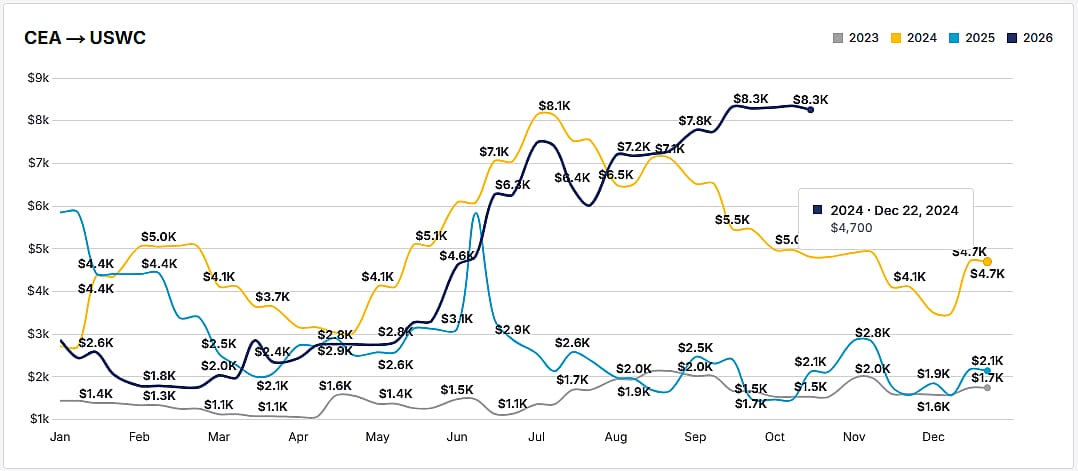
CEA to USWC: Standard market rates are hovering around $8,000/FEU. However, secondary volume discount rates are available at $6,900 to $7,000/FEU for multi-container commitments. Rates have remained unchanged relative to the first half of the month.
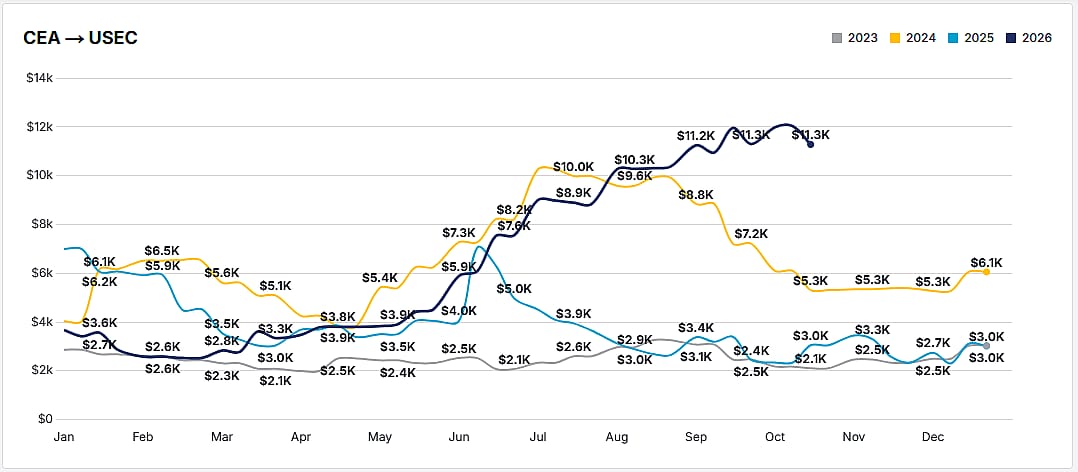
CEA to USEC: Rates continue to hold in the $9,000+/FEU range. Special blended rates for higher-volume bookings are holding near $8,450/FEU. As with the West Coast, rates have shown no net increase or decrease week-over-week.
Freight Right’s Lowest Rate indicators are finding that importers can find spot rates as low as $6,400 from China to U.S. West Coast and $8,129 from China to U.S. East Coast.
Read more about the state of the ocean freight spot market with Freight Right’s TrueFreight Index.
A Closer Look:
Looking Ahead
Space constraints are expected to continue through the end of October as carriers clear holiday backlogs. Booking at least two weeks before the intended departure is increasingly necessary, though it does not guarantee space or prevent a rollover.
Rates could remain near current levels into November and December if carriers continue to control capacity, even without a substantial increase in demand. A further increase ahead of Chinese New Year is possible, but this week’s discussion does not confirm a new ocean rate increase.
For shippers, the immediate priority is building more time into shipment plans. Departure dates, terminal receiving windows, and transshipment connections remain subject to change. If a delay moves a container into a new pricing period, a future rate increase could also affect the final cost.
Paying the current market rate does not guarantee priority loading or an on-time departure. Confirm space, rate validity, and receiving dates before arranging container pickup, and allow additional time for shipments with firm delivery deadlines.
China to U.S. air freight rates rose sharply after the National Day holiday, reversing the usual seasonal pattern. Airlines typically offer lower prices during and immediately after the Oct. 1-7 break to fill space. This year, capacity remained tight during the holiday, and the market has seen two to three rounds of price increases since factories resumed work on Oct. 8.
CEA to USWC: Rates are trending higher, with further increases expected this week. The Week 41 sheet lists standard-density carton rates to LAX at approximately $5.85-$7.69 per kg, depending on origin and routing. Comparable SFO rates range from approximately $5.85-$6.77 per kg.
CEA to USEC: East Coast services face the same upward pressure. Standard-density carton rates to JFK range from approximately $6.88-$8 per kg, with direct Shanghai–JFK service at the upper end.
A Closer Look:
Looking Ahead:
Based on this past week’s market report, upward rate pressure is expected to continue through the end of December. Reduced airline capacity, higher fuel costs, and growing technology shipments are coinciding with the traditional peak season for U.S.-bound exports.
Shippers should book early, confirm space alongside pricing, and budget for further increases. Direct and connecting services already show meaningful price differences, making routing flexibility useful where delivery schedules allow. Quotes should be reconfirmed before booking as airlines continue to adjust rates.
This story was produced by Freight Right and reviewed and distributed by Stacker.


