Tuesday, October 27, 2026
Clear, 66°Wind: mph,


Welcome to our new web site!
To give our readers a chance to experience all that our new website has to offer, we have made all content freely avaiable, through October 1, 2018.
During this time, print and digital subscribers will not need to log in to view our stories or e-editions.

Whether it’s generating code or debugging failures, AI tools have become remarkably proficient at the operational work that companies depend on today. There’s no question that, in certain areas, productivity has gone up. But the same AI is also multiplying demand — expanding what needs to be managed and opening data access to far more people across the business than ever before.
Data engineers are often caught in the middle, building and maintaining the pipelines and infrastructure that every AI workflow relies on. When a new data source needs to be integrated, or an AI agent breaks because of unreliable data, they are the ones called in to fix it. These teams are adopting their own AI tools to keep pace, but many still seem to be falling further and further behind.
An MIT Technology Review report on “Redefining Data Engineering in the Age of AI” found that while 8 in 10 organizations have deployed AI-based data engineering tools, data engineers are also managing more complexity with the biggest challenges reported as ensuring data security and privacy (55%).
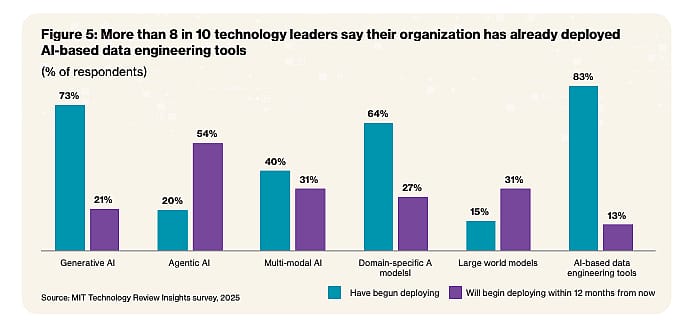
Coding tools alone aren’t enough. As Snowflake outlines below, this requires a more fundamental shift. Instead of looking to AI to make existing processes run faster, it's time to rethink the processes themselves and move beyond manually manipulating pipelines. Tomorrow's data engineers won't be so concerned with rote engineering as they will be the output of that work, the data product. Consisting of clean and curated data, metadata, context and tools, these data assets are meant to be reliable and reusable, ready for not just humans, but also AI agents.
The future data engineers will focus on creating these data products to fuel business decisions. Truly autonomous agents will then build, maintain and optimize everything needed to keep those products up to date, with humans as the key decision makers and arbiters.
Paying attention to new products needed, problems and failures with existing ones, agents will independently search for opportunities to improve, clean up and optimize. Meanwhile, humans will have more elevated roles, working closely with business teams to define the most important business problems, guide the agents on the right overall architecture and make sure that the context of the business is appropriately captured for the agents consuming the data products.
This is a big shift, and teams won’t be able to get there overnight. Nor should they. A better approach is to align on the right goal, and then move toward it incrementally and thoughtfully. At each step, teams will learn more about what the agents and models are capable of, and will build trust in how much can be safely automated, and where you need additional human-in-the-loop checks, tooling or processes. Many companies are already underway: Every team that has adopted a software-defined lifecycle, version control, declarative pipelines or AI-assisted development has taken a step toward the future.
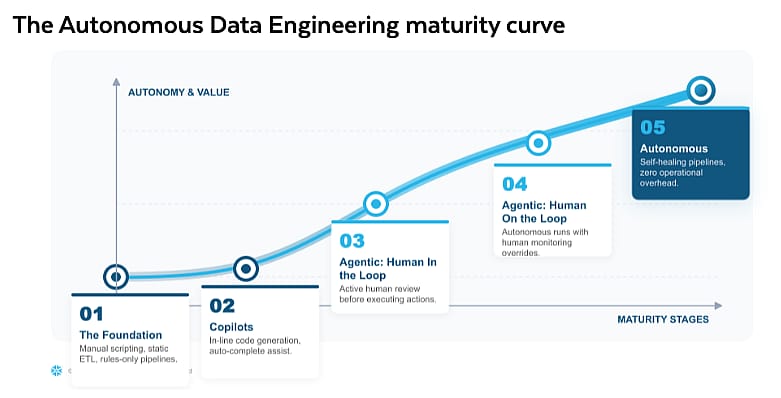
At Stage 1, the foundation, data engineers build and maintain pipelines manually. Every schema change, orchestration decision and failure response requires human effort. Teams that treat this phase as the time to get their engineering fundamentals right will have more success in later stages. Movement to more modern data engineering practices, such as declarative pipelines, can generate improved efficiency.
Stage 2 is where AI enters the editor. Autocomplete and inline code generation reduce the friction of transformation and configuration, but engineers still own every decision. The fundamental workflow hasn't changed, even though output has increased.
Stage 3 is where AI starts becoming a collaborator. Agents can propose changes like pipeline modifications, failure fixes and schema migrations, but nothing executes without explicit human approval. Engineers review code instead of writing it, shortening incident response time dramatically.
Automation benefits begin to truly shine at Stage 4. Agents act independently on select, clearly defined tasks, such as detecting anomalies and adapting pipelines to upstream changes, without waiting for approval. Engineers still have observability into what agents are doing and can override agents' actions when necessary.
At Stage 5, data engineering has fundamentally changed what it means to work in data. Pipelines detect their own failures and root-cause issues across the stack, apply fixes, validate outcomes and document what changed without human intervention. Operational overhead approaches zero.
Data engineers define the policies, standards and business semantics. They also decide what the platform is allowed to do autonomously and what requires their judgment, so high-impact changes are routed to human review. Their role is fully shifted from execution to governance, and they've elevated from pipeline builders to genuine business partners.
Moving closer to a future with autonomous data engineering (ADE) requires a shift from thinking about data pipelines to thinking about data products, which encompass not just data but semantics, quality and everything needed to make data reliably usable. For example, a customer loyalty data product may include customer churn-risk data, which pairs each individual account-activity data with a shared business definition of what "at-risk" means, along with documented quality checks. Any agent or analyst accessing this data product would then get a consistent, trustworthy answer for their customer loyalty efforts.
The traditional model starts from infrastructure and builds up: Build the data foundation, define schemas, create pipelines, then serve a business need. That worked when data products were few and stable.
But modern data teams often need to run this in reverse: Start with the business problem and work back to design the information you need to make a decision or automate a workflow. This reorients the data estate around business outcomes rather than technical layers, introducing a vertical approach to data engineering where pipelines are designed for results, not schemas.
In true autonomous data engineering, the architecture of your data estate matters as much as the choice of agent framework. Governance, interoperability and a connected data estate are the preconditions that make it safe to trust autonomous workflows. Modern engineering practices must also be in place. Version control, automated testing and CI/CD pipelines — the same best practices that high-performing data teams have been adopting for years — underpin automation.
The technical pieces of ADE are becoming available. The organizational ones — governance frameworks, clear accountability, shared definitions of what good data looks like — take longer to build and matter just as much.
ADE is where most organizations are headed, whether they've named it or not. Getting there is a matter of taking the organizational work as seriously as the technical.
In an ADE world, the pipeline details become the agent's concern. The engineer's attention moves up to the policies that govern what the agent is allowed to do, the standards that define what good data looks like, and the business context that makes any of it meaningful.
This is a different kind of expertise — less about building and more about defining. And it turns out, the organizations that are most ready for autonomous workflows are the ones that invested earliest in that kind of thinking.
This story was produced by Snowflake and reviewed and distributed by Stacker.


