Monday, November 16, 2026
Clear, 57°Wind: mph,


Welcome to our new web site!
To give our readers a chance to experience all that our new website has to offer, we have made all content freely avaiable, through October 1, 2018.
During this time, print and digital subscribers will not need to log in to view our stories or e-editions.
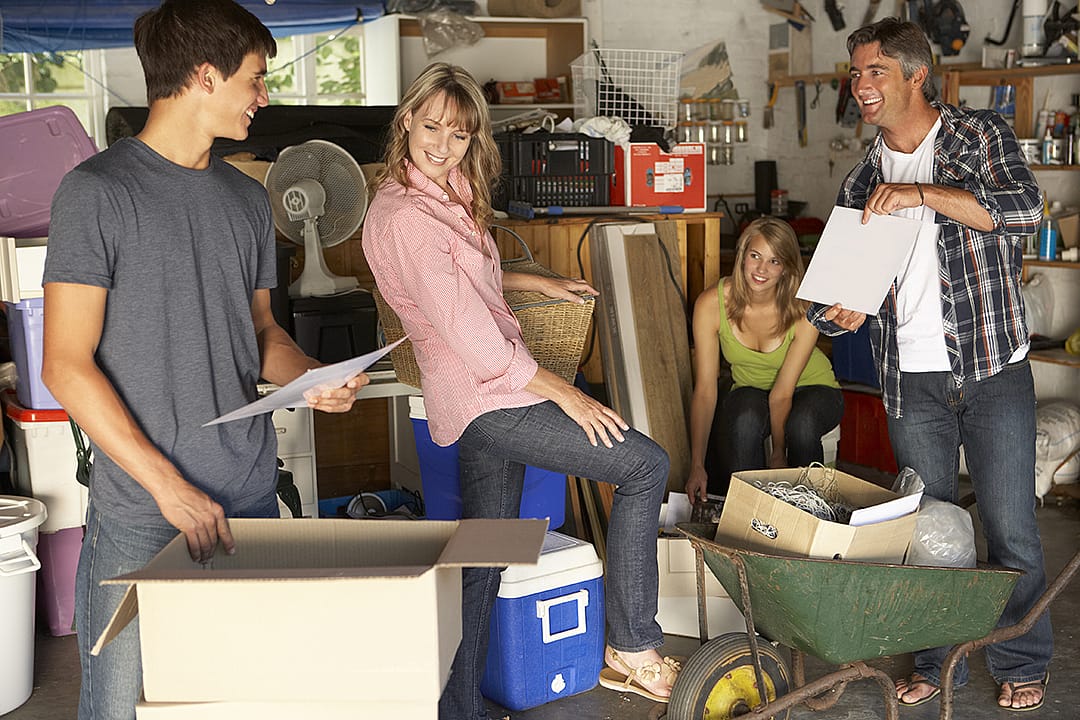

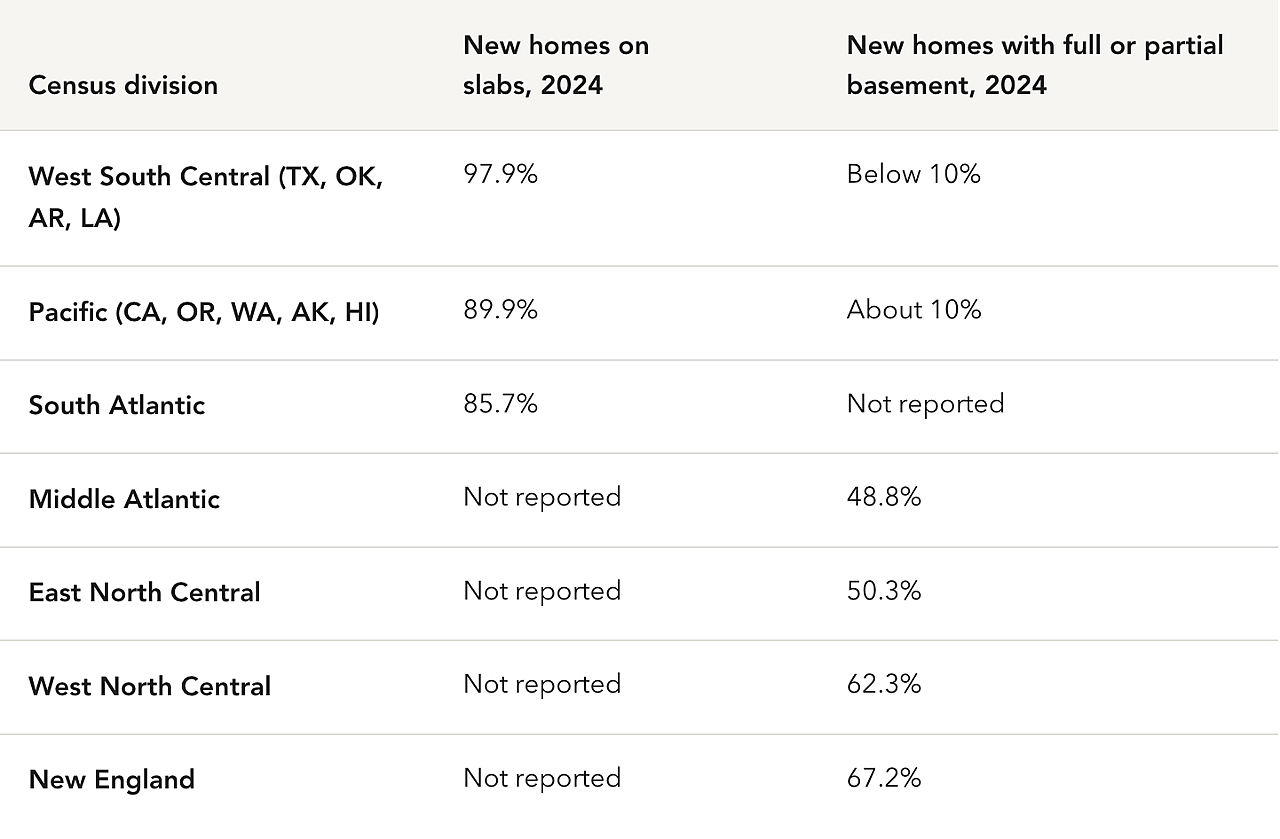
Nearly nine in 10 new homes in the Pacific states sit on a slab. For the folding tables, extra chairs and oversized pans that come out one week a year, that leaves the garage, and the garage has rules.
Most new homes in the West and South have no basement, so the garage becomes the storage room for everything that comes out once a year. That works for metal, glass and sealed bins, and it can ruin candles, batteries, paper and clothing, especially in desert heat. A keep, rent or borrow rule shrinks the pile, and what is left can fit on about one shelf's worth of space if it is stored on purpose. Closet World, which designs closet and garage storage in California and Las Vegas, looked at the housing and weather data to determine where once-a-year things should live the other 51 weeks.
Key Takeaways
Garages fill the gap. According to the Department of Energy's summary of the American Housing Survey, 76% of occupied homes in the West and 72% in the Midwest have a garage or carport, compared with 56% in the South and 49% in the Northeast. For a slab-foundation household, that garage is attic, basement and utility room at once.
Las Vegas's normal daily high in July is 104.5 F, and the city hit 120 F on July 7, 2024, according to the National Weather Service. An uninsulated garage can get hotter than the air outside. That is the condition a stored box has to survive, and some categories do not.
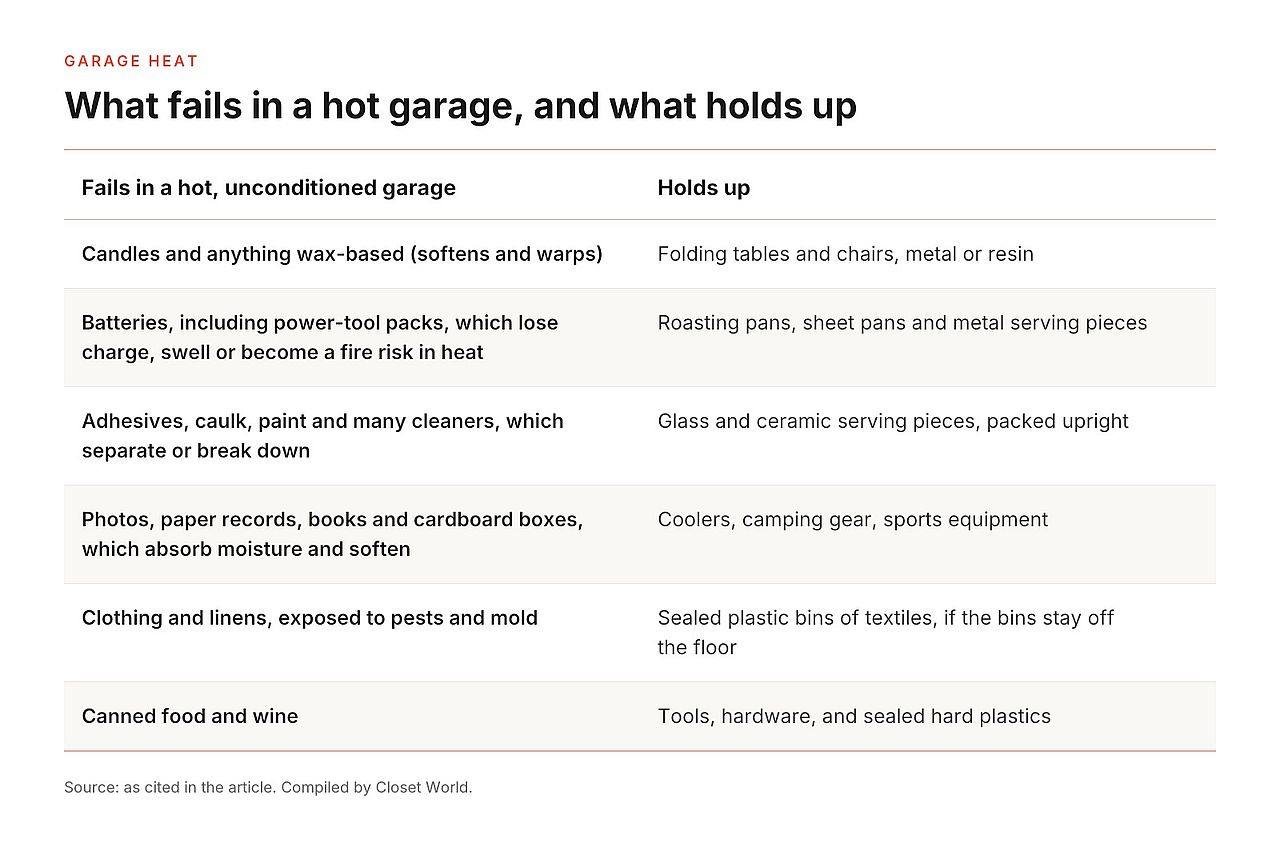
"Clothing is susceptible to mold and damage from pests," Katherine Lawrence, a professional organizer and founder of Space Matters, told SpareFoot, which also notes that cardboard absorbs moisture and softens. As for batteries, a DeWalt product manager told Bob Vila that power-tool batteries should not be stored in a hot or humid garage. Keep those indoors, in a closet or cabinet, and let the garage hold what heat cannot hurt.
Before measuring a shelf for something, decide whether it has earned the space. A workable rule:
Cara Palmer, a professional organizer and the owner of Organize Every Room, told Homes & Gardens to ask, "Could I borrow or rent this instead?" She called the question "particularly powerful for items you'll use infrequently."
Measure them the way a mover would: length by width by height, in inches, then divide by 1,728 to get cubic feet. A typical tally for a household that hosts one big meal a year looks like this.
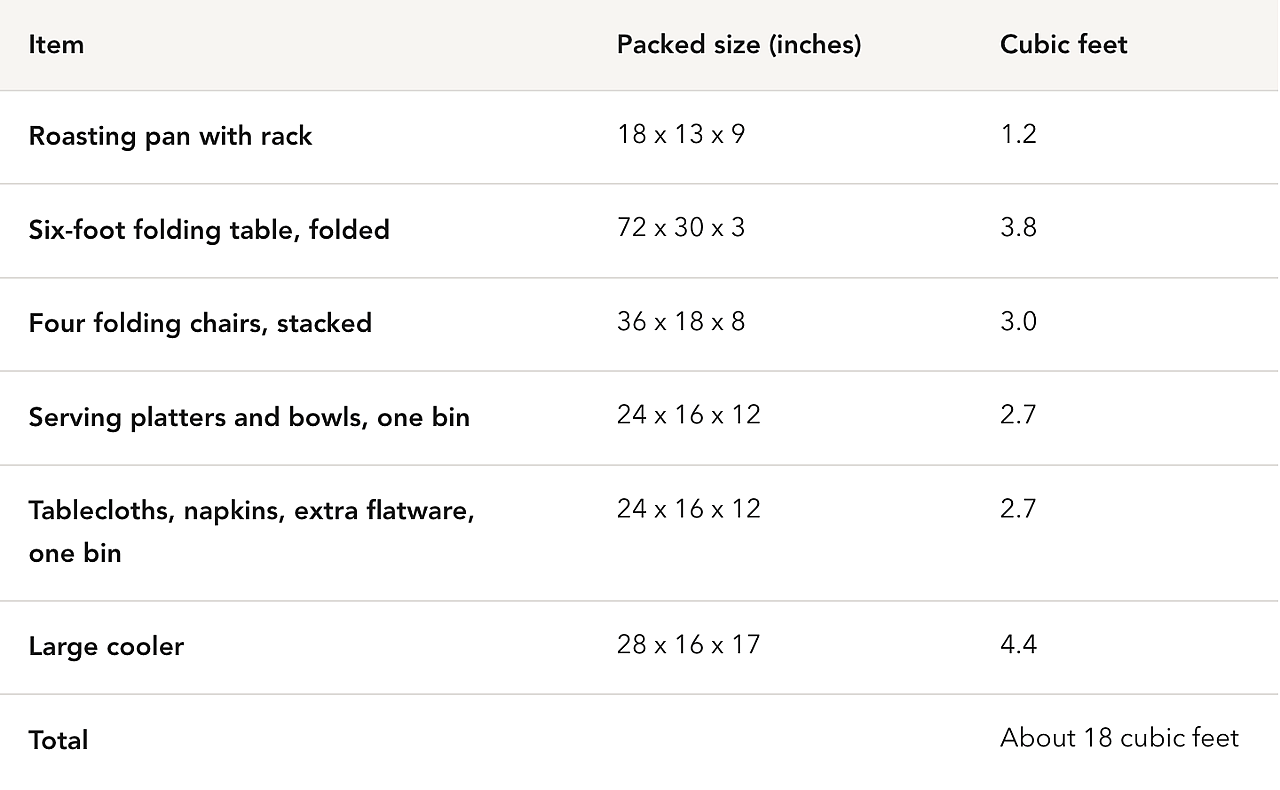
Eighteen cubic feet is roughly equivalent to a stack roughly 2 feet deep, 3 feet wide and 3 feet tall: one section of a garage shelving unit, or the top shelf and floor of a hall closet. Written down, it is a manageable number. Spread across a kitchen, a hall closet and the garage floor, it reads as clutter in three rooms.
Put the heavy pieces low and the heat-sensitive pieces inside. "Storing infrequently used platters and serving dishes in upper cabinets frees up space in lower cabinets for often-used kitchen items," Julie Peak, a professional organizer and owner of The Precise Place, told Livingetc. Roasting pans and stacked chairs belong on a low shelf or the floor of a garage rack, where they're easier and safer to lift. Tables and coolers can hang on wall hooks. Linens and paper go in a sealed bin in a closet, not the garage. Label every bin on both sides, and store the bins where the host can reach them without a ladder.
This story was produced by Closet World and reviewed and distributed by Stacker.


