Thursday, October 1, 2026
Clear, 65°Wind: mph,


Welcome to our new web site!
To give our readers a chance to experience all that our new website has to offer, we have made all content freely avaiable, through October 1, 2018.
During this time, print and digital subscribers will not need to log in to view our stories or e-editions.

If founder mode says the pure people manager is finished, that means the founder has to build the thing and negotiate the deal, close the skeptical buyer, deliver the feedback nobody wants to give, and more. That's a lot to learn. So, how are founders doing it? They’re hitting the bookstore.
In this article, Brex examined book spend data across all of its customers, and one thing was consistent: Founder mode was written all over the receipts.
A year ago, operating manuals were the most-purchased books. In the first half of 2026, a biography of Alex Karp, the cofounder and CEO of Palantir, tops the list, followed by a wave of books about the work founders won't hand off.
Leaders are going full founder mode by devouring books about builders who are changing the world, from defense systems to restaurant empires to battlefields.
Data is for the first half of 2026, with “Movement” indicating the change in rank compared with the same period a year earlier (H1 2025), and “NEW” indicating no appearance in the rankings during H1 2025.
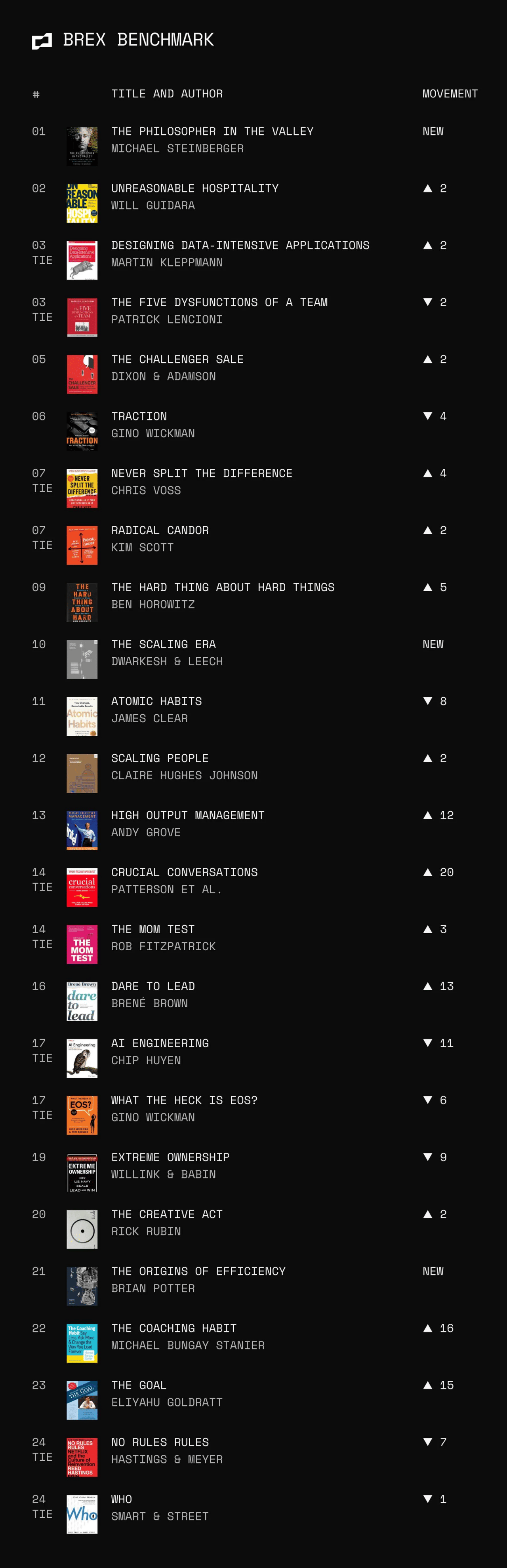
A few titles sitting just outside the top 25 that belong in this story:
Startup readers want to learn from the founders themselves. A playbook might tell you how to run the company, but the biographies tell you who you have to become to run it.
These founder and CEO biographies trended up this year:
The first wave of founder-as-personal-project reading hit a ceiling. Everyone bought “Atomic Habits,” everyone built a morning routine, and a lot of those routines faded. The whole optimize-yourself shelf lost ground at once:
What's pulling away: hard feedback, skeptical buyers, and coaching conversations. These are the skills of someone who does the work, not someone who manages it.
“The Scaling Era,” Dwarkesh Patel's oral history of how the models actually got built, with Dario Amodei, Demis Hassabis, Ilya Sutskever, Mark Zuckerberg, and others, debuted at #10. And “Designing Data-Intensive Applications,” a 700-page distributed-systems textbook, is tied for third, up 44% from a year ago. A systems engineering textbook is the #3 book among founders.
The people running companies are reading the deep technical material themselves, because in founder mode, there's no layer between them and the machine.
Stripe launched its press in 2018 with a handful of titles a year, betting that operators would pay for beautifully made hardcovers about science, economics, and technology. Books for "an audience that is global, fiercely curious, and extremely high-agency," in their own words. A leading global payments company is now outperforming 200-year-old publishers.
Three of the top 25 are Stripe Press hardcovers, and two more are in the honorable mentions:
Just outside the top 25: “An Elegant Puzzle” (Will Larson) and “The Art of Doing Science and Engineering” (Richard Hamming)
Founder mode has animated two years of podcasts, panels, and essays, and for good reason. It's a leadership idea that came from the founders themselves, not the theory shelf. The Brex data adds something new to that conversation: Whatever founders say, they also vote with their corporate cards. They've picked up the founders who came before them, the story of how the machines they now command got built, and they're still reading Grove while they do it.
So compare your bookshelf to the list. Are you operating the way the data says founders operate now, or are you still reading the faders?
Rankings come from anonymized Brex card purchases of books tagged by ISBN. The ISBN-level detail comes from L2/L3 card data that Brex uses to auto-generate itemized receipts on purchases like these. Cardholder purchases per month were counted and summed across each period. For momentum, each title's rank in H1 2026 was compared with the same window a year earlier, which controls for the seasonality of when companies buy books.
This story was produced by Brex and reviewed and distributed by Stacker.


