Wednesday, October 21, 2026
Clear, 73°Wind: mph,


Welcome to our new web site!
To give our readers a chance to experience all that our new website has to offer, we have made all content freely avaiable, through October 1, 2018.
During this time, print and digital subscribers will not need to log in to view our stories or e-editions.


Four hundred and twenty-eight years ago, Don Juan de Oñate famously carved into the cliff at El Morro “Pasó por aquí” as he established the first permanent Spanish colony near Santa Fe. On their way north, the caravan “passed by here,” past the future city of Las Cruces as they went up El Camino Real de Tierra Adentro, the Royal Road to the Interior Lands.
Since 1598, Spanish colonial governors, soldiers, priests, traders, and fortune seekers trekked 1,500 miles over deserts and mountains, moving 10 to 15 miles a day to go from Mexico City to Santa Fe in six months. One of the most difficult sections of the Royal Road lay just north of Las Cruces as caravans faced the dreaded Jornada de Muerto, a 90-mile waterless stretch of the Chihuahuan Desert.
To prepare for the Journey of the Dead, caravans rested at the Paraje San Diego. At this campsite, they gathered Rio Grande water, fixed wagons, and checked on their horses, cattle, oxen, and sheep. They had to anxiously dash across the Jornada in just a few days before they ran out of water.
This paraje was an important place on the Camino because it provided a resting place for the historical people who passed by here. Oñate and Spanish settlers, colonists fleeing the Pueblo Revolt of 1680, Spanish soldiers on their way north to reconquer Pueblo Indians in 1692, Mexicans who won their independence after 1820, and Santa Fe Trail traders on their way to Chihuahua.
In 1846, the U.S. Army also passed by here when it invaded Mexico during the Mexican American War. Texan Confederates camped here as they attacked New Mexico during the Civil War. And then in 1881, the railroad passed near here, putting the Royal Road out of business.
This sounded like a perfect place to visit, so the Doña Ana County Historical Society organized a field trip to this desert campsite and into our Spanish colonial past.
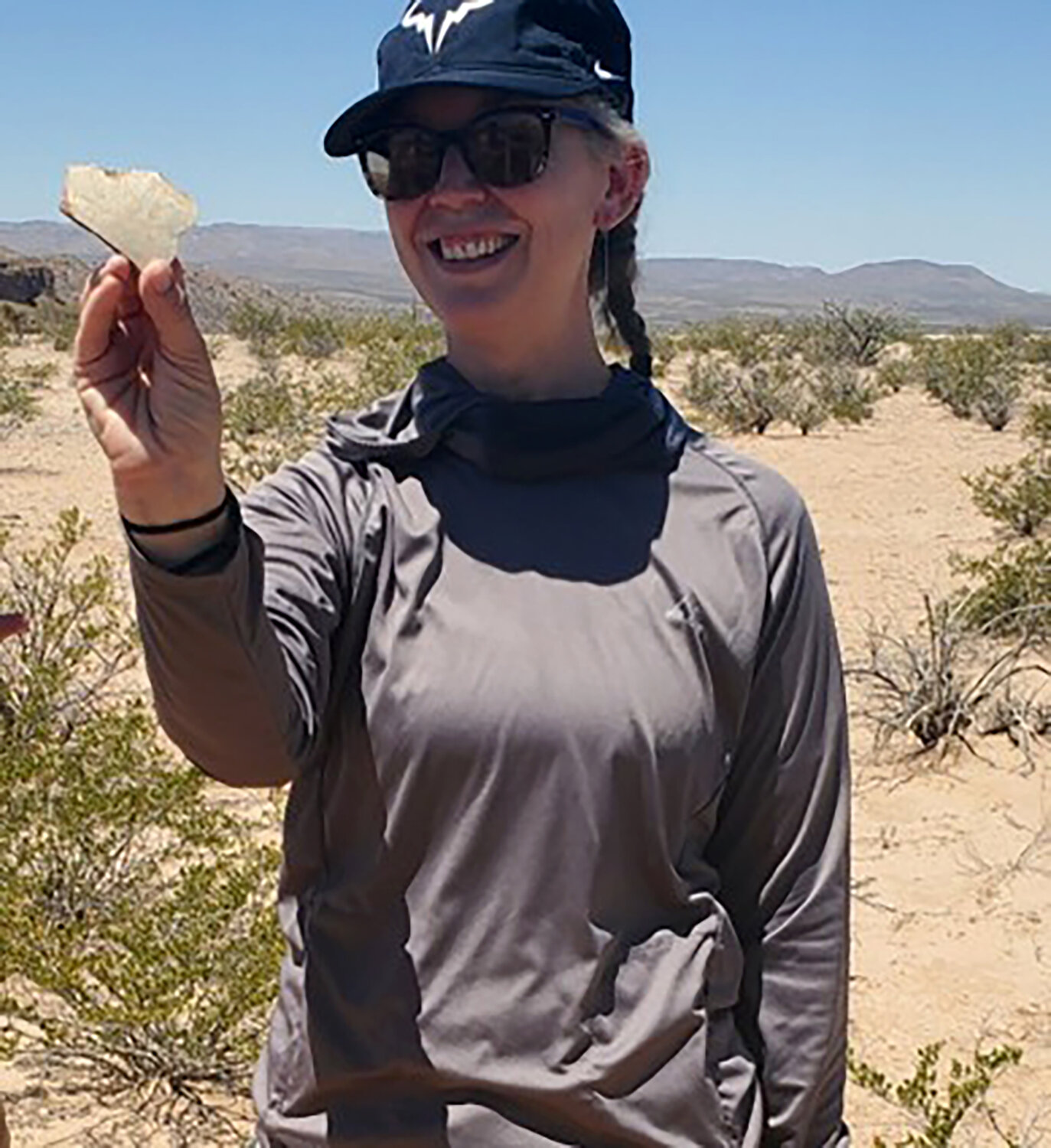
On May 9, members from DACHS and the public car-pooled up I-25 and then drove five miles on a dirt road to a lonely spot in the desert. We heard a brief historical overview of the Camino Real and Paraje San Diego and then Dr. Kelly Jenks of NMSU’s Anthropology Department and director of the University Museum shared her knowledge derived from her work at the site with her students. She talked about life at the paraje as travelers prepared to dash across the Jornada.
She hinted at what we might find on the ground from hundreds of years of human usage. Blackened stones from fire pits 250 years ago. Stone tools. Broken pieces of pottery. Holding up a pottery piece, Kelly said it was from a Spanish olive jar.
Some of us followed Kelly asking about the past. Then just before we left, a man saw small fragments of blue and yellow glazed pottery in the sand. Kelly said the blue piece was probably made in Mexico in the 1700s. The yellow glazed fragment Kelly said was probably from the 1600s. Both pieces were Majolica pottery. As enticing as it was to keep these treasures, we put them back where we found them for future archeologists.
In this desolate part of the Chihuahuan desert, we found actual bits of our Spanish Colonial past and enjoyed imagining we were traveling on El Camino Real hundreds of years ago. And we now can say that we too pasó por aqui.
To celebrate the 250th anniversary of the Declaration of Independence, DACHS will have other field trips, walking tours, lectures, and activities focusing on our local history.
For more information, visit us at http://www.donaanacountyhistsoc.org.


