Tuesday, October 27, 2026
Partly Cloudy, 53°Wind: mph,


Welcome to our new web site!
To give our readers a chance to experience all that our new website has to offer, we have made all content freely avaiable, through October 1, 2018.
During this time, print and digital subscribers will not need to log in to view our stories or e-editions.
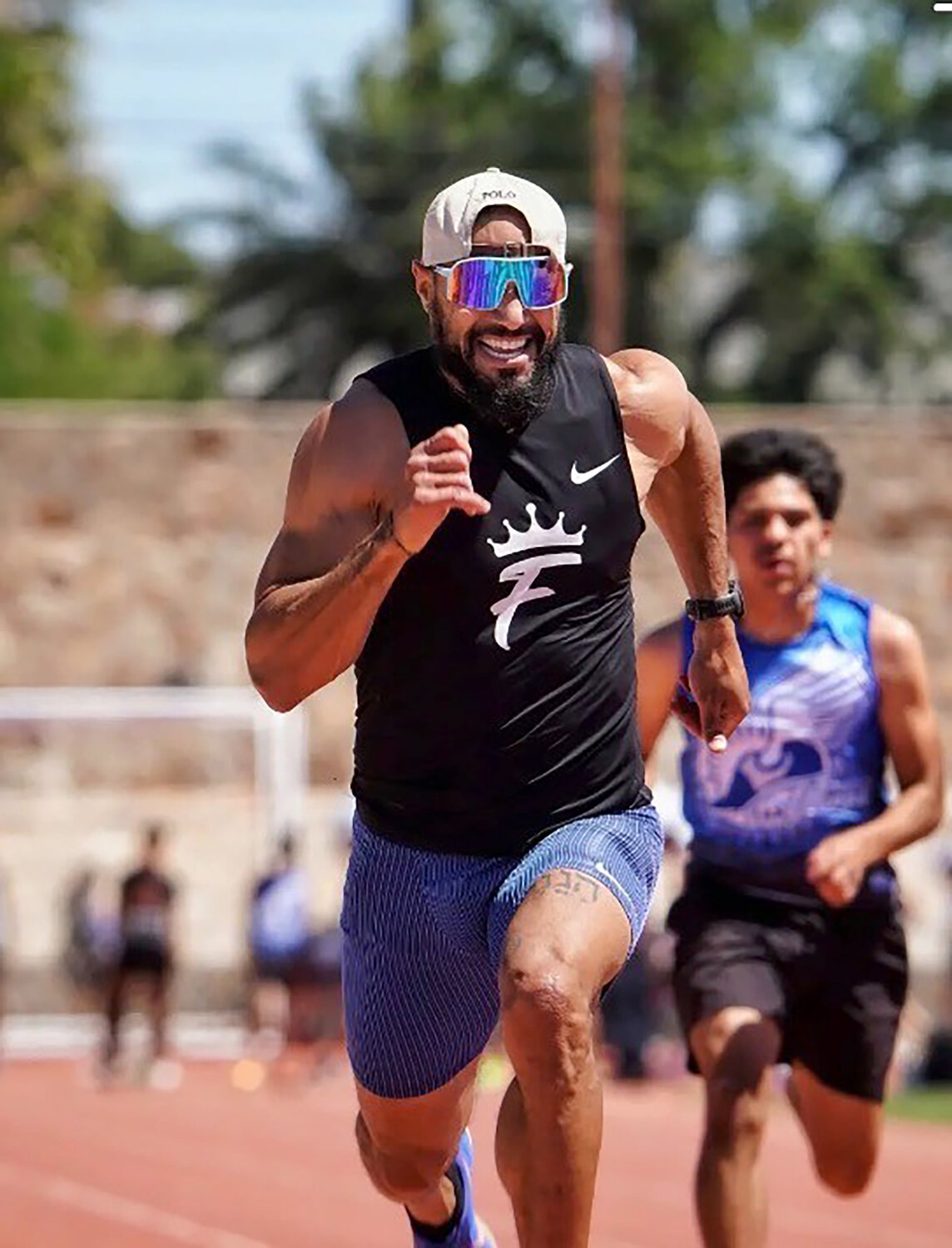


The runners settling into the starting blocks at the USATF Masters National Championships have spent years chasing fractions of a second. Many were accomplished track athletes long before they reached the Masters ranks, refining starts, perfecting stride mechanics and learning every nuance of the sprint.
Siddeeq Shabazz arrived by a different route. The Chaparral native, former NFL draft pick and New Mexico State University assistant professor of marketing isn't revisiting an old track career. In many ways, he's discovering one for the first time.
When he lines up at the national championships this month, he'll do so ranked No. 1 in the United States and No. 2 in the world in the men's 45-49 100-meter dash, while also ranking second nationally and fifth in the world in the 200 meters. Those accomplishments come less than a year after recovering from health concerns that temporarily sidelined his training and after navigating one of the most difficult periods of his personal life. They also come after a lifetime of taking paths few would have predicted.
Ask Shabazz how he got here, and he rarely starts with medals or rankings.
Instead, he starts in Chaparral.
Growing up on a modest five-acre property, his days revolved around chores, goats, ducks and moving piles of rock as his father built what Shabazz still describes as a rock castle. The children were the labor force, and the work wasn't optional. Looking back, he believes those years shaped far more than his physique.
"I think it taught me discipline and hard work," he said. "Most youngsters don't really tend to have that unless they're part of something big like organized sports most of their life."
Ironically, organized sports were only a small part of his childhood. He played football in eighth grade and as a freshman before leaving the game to help on the family property. He slipped back into track as a junior and returned to football for his senior season, hardly the resume of someone destined for professional football.
Even then, Shabazz wasn't a highly recruited athlete. When he approached the University of Texas at El Paso and the University of New Mexico about scholarships, the answer was no. New Mexico State offered him something different. A preferred walk-on opportunity.
"I didn't know what that meant," he said with a laugh. "But I came and the rest was history."
History, however, wasn't immediate. Walk-ons rarely receive the benefit of patience or expectation, and Shabazz spent three years trying to prove he belonged. He redshirted his first season, spent two more contributing mostly on special teams and became accustomed to filling whatever role coaches needed.
"There was always a guy in front of me," he said.
Rather than resent it, he turned each teammate into a benchmark. If someone started ahead of him, that became his next goal. He watched. He learned. He worked.
The physical transformation mirrored the mental one. The 165-pound freshman who arrived in Las Cruces eventually grew into a 205-pound receiver capable of running a hand-timed 4.29-second 40-yard dash. By his junior season he had earned a starting role.
Eventually, the Oakland Raiders made him a seventh-round draft pick. From the outside, it looked like the payoff for years of perseverance. Inside the NFL, Shabazz discovered perseverance had only become more necessary.
Professional football proved every bit as uncertain as college had. Roster decisions, injuries and circumstances beyond his control repeatedly altered his path. He spent time with multiple organizations, including the Raiders, Atlanta Falcons and later in the Canadian Football League, learning quickly that talent alone didn't determine longevity.
Nothing, he says now, has unfolded exactly according to plan. "Everything's been kind of adjust as you go, pivot after pivot after pivot," he said.
Yet through every pivot, one constant remained — the work ethic.
"I don't think you can out-intelligence hard work," he said. "A lot of people aren't willing to put in the work that it takes to be great at something."
That mindset eventually carried him beyond football.
During his rookie season, Shabazz found a mentor whose work centered on leadership, health and personal development. The lessons expanded his understanding of success beyond athletic performance and ultimately helped redirect his career.
Years later, after returning to Las Cruces, he earned a master's degree and later a Ph.D. at NMSU before joining the faculty in the College of Business as an assistant professor of marketing. His research focuses on employee well-being, work-life balance and organizational health — subjects that mirror many of the lessons he says life has taught him. Teaching, he says, became a natural extension of who he already was.
"I've always been the type of person who wants to pass on what I learn," he said.
That same desire has fueled his work away from campus. For years, Shabazz organized free football camps designed to reach children who, like him growing up in Chaparral, might never otherwise have the opportunity to attend one. The camps mixed football instruction with conversations about leadership, discipline and life skills, drawing support from friends and community volunteers throughout Las Cruces.
Last month he returned to Chaparral to conduct another free camp for defensive backs. Watching young athletes navigate many of the same obstacles he remembered from childhood only strengthened his resolve.
"It reminded me of how rough that community was that I came from and how much need there is there," he said. "It just sparked the desire to continue to do that type of work in communities like that."
The competitive fire, meanwhile, never disappeared. Ironically, his return to elite athletics came almost by accident.
After completing his Ph.D., Shabazz entered perhaps the most sedentary stretch of his life. Persistent hip pain convinced him he might need replacement surgery. Instead, physicians delivered unexpected advice. Train harder. As he rebuilt strength, the pain largely disappeared. His body responded almost immediately.
"I got dang near as strong as when I was playing in college and in the NFL," he said.
The transformation reminded him that perhaps his athletic career wasn't finished after all. He initially pursued distance running, even completing a marathon while trying to lose weight, before realizing his body remained better suited to explosive movement than endurance. So, he returned to sprinting.
The transition wasn't seamless. Knee injuries interrupted training, and even after winning a national championship in the long jump, setbacks continued. More recently, a comprehensive NFL health evaluation revealed changes in his heart that initially raised fears he had suffered a heart attack. Further evaluation suggested the findings were more consistent with stress-related cardiac changes than permanent damage, forcing him once again to rethink his training and recovery. The experience, combined with stem cell treatment later in the year, reinforced a lesson he admits took decades to learn: peak performance depends as much on caring for the body as pushing it.
Yet even that chapter became another beginning. Last winter, he entered his first indoor national championship in the 60 meters almost on a whim, registering on the final day before entries closed. He won.
Now, with outdoor rankings placing him among the fastest Masters sprinters in the world, he believes his best performances may still lie ahead.
One goal remains unfinished. As a high school senior, Shabazz ran approximately 11 seconds in the 100 meters. More than three decades later, he still wants to beat that mark.
Eventually, he hopes to break 10 seconds and perhaps one day challenge the age-group records held by former Raider receiver and Olympic sprinter Willie Gault.
That ambition surprises some people. It doesn't surprise Shabazz. For him, competition has never been about proving someone else wrong. It's about refusing to settle for average.
During Masters meets, he often finds himself inspired not by fellow competitors in their 40s, but by runners in their 70s, 80s and even older — athletes who continue sprinting with remarkable energy and joy.
"They're showing me a picture of health that's different than the average American experience," Shabazz said. "I want to be in that club."
Perhaps that's the thread connecting every chapter of his life, from the boy hauling rocks on a Chaparral farm to the overlooked walk-on who became an NFL player. From the professor and mentor to the Masters sprinter.
Each version of Siddeeq Shabazz has been chasing the next finish line, not because reaching it means he's arrived. Almost inevitably, another one is already waiting.
"It's kind of the story of my life," he said. "I have a new goal already even though I haven't met that goal yet."


