Tuesday, October 27, 2026
Partly Cloudy, 53°Wind: mph,


Welcome to our new web site!
To give our readers a chance to experience all that our new website has to offer, we have made all content freely avaiable, through October 1, 2018.
During this time, print and digital subscribers will not need to log in to view our stories or e-editions.
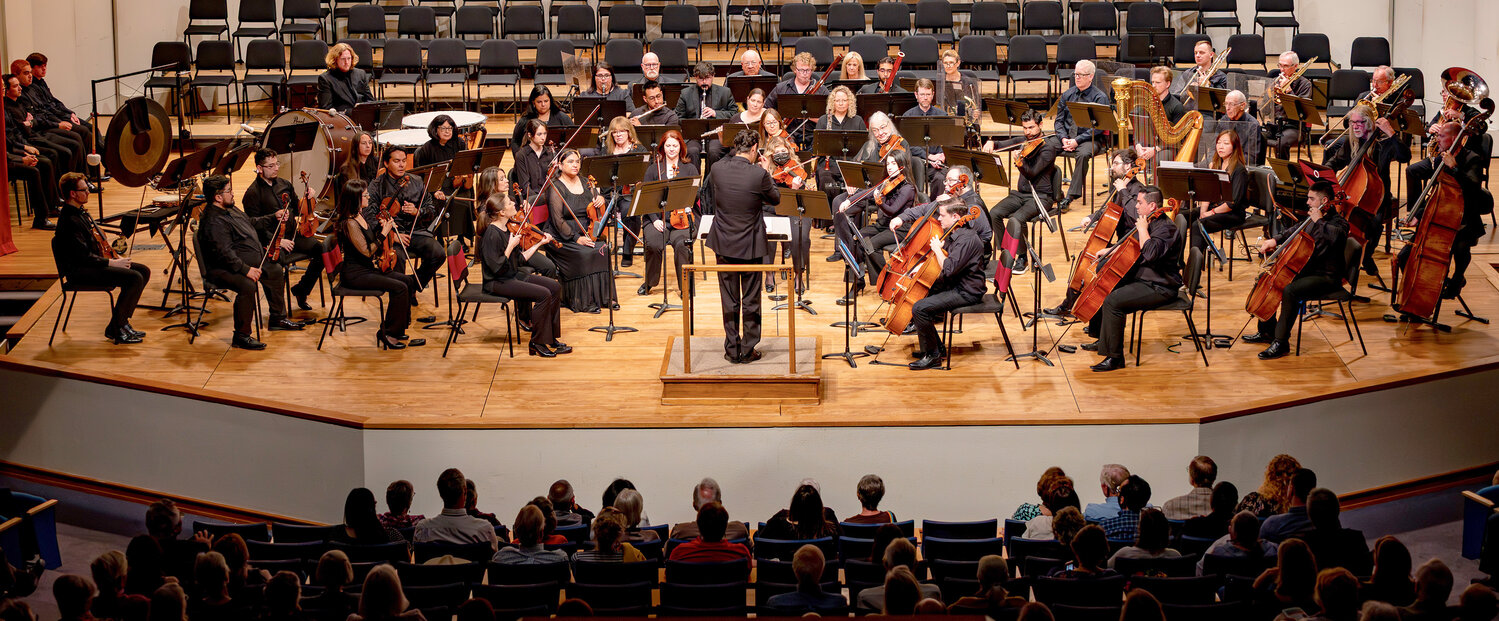


It's not the opening measure or the difficult flute passage she's practiced countless times that excites Joy Zalkind as she prepares to perform. As the audience settles in and conductor Jorge Martinez-Rios raises his baton, she feels the anticipation from the stage at Atkinson Recital Hall.
She’s preparing for the moment when the orchestra reaches full voice. From her chair in the middle of the woodwinds, she watches the sea of violin bows rise and fall in front of her. Behind her, the brass and percussion gather strength. Then the sound arrives, not simply through her ears, but through the stage beneath her feet.
"The floor vibrates," she says. "You can actually feel the sound waves."
For concertmaster Brigid McCarthy, the experience begins differently. From the first chair of the first violins, she isn't listening only to her own instrument. She's watching dozens of musicians breathe together, matching bows, shaping phrases, quietly leading an orchestra toward becoming something no individual musician can create alone.
One experiences the orchestra from its center. The other from its front edge. They have different vantage points united by the same lifelong pursuit.
That quest is the story of the Las Cruces Symphony Orchestra, a community institution now entering its 65th season, carried forward by musicians whose paths to southern New Mexico began thousands of miles apart but who arrived believing the same thing, that music is less about performance than it is about connection.
For Zalkind, it started with buttons. Growing up in New Jersey, she was about 10 years old when she saw someone playing the flute. She doesn't remember deciding she wanted to become a musician. She remembers wanting to touch the instrument.
"I thought it was the most beautiful instrument I'd ever seen," she says. "I just wanted to press all of the buttons." She laughs at how simple the memory sounds now. "But that's really the truth."
She picked up the flute in fourth grade. Making a sound on the instrument can frustrate beginners, but somehow it came naturally to Zalkind.
"I was able to make a sound immediately," she says. "I loved every second playing the instrument. The flute has been my lifelong teacher."
That sentence carries more weight than a resume ever could. More than five decades later, she’s still learning.
The principal flutist has studied at The Hartt School in Connecticut, earned a master's degree at the University of New Mexico and later completed advanced flute studies at Carnegie Mellon University. She has performed professionally in El Paso and Las Cruces and now teaches at El Paso Community College while maintaining a private studio.
But when she talks about music, accomplishments quickly give way to something else. Commitment, discipline, heartbreak, and personal growth.
"Music is the lesson of life," she says. "I really don't know how to say it any better."
McCarthy's beginning couldn't have been more different. Music wasn't something she discovered. It was simply always there.
Her father, who had begun learning fiddle as an adult, played around the house. Her older brother took Suzuki violin lessons. Before long, the family had formed its own little ensemble, with her father playing harmony, her brother somewhere in the middle and Brigid carrying the melody.
She grew up in St. Paul, Minnesota, surrounded by music long before she understood it as a career.
"My mom always had music on," she says. "When I was going to sleep, when I was taking naps. It was always there."
As a teenager, she found something even more powerful than practicing scales.
She found chamber music. Playing string quartets taught her that music wasn't simply about individual excellence. It was about conversation — listening as much as playing.
"The way you connect to your fellow musicians in a small ensemble is really incredible," she says.
That idea has never left her. Even now, as concertmaster, she doesn't describe her role as leading from the front as much as helping everyone breathe together.
"I'm really trying to bring people together," she says. "Technically together, but also feel the music together, which we have to do in order for the audience to feel it."
It may be the simplest explanation of an orchestra anyone could offer. If the musicians don't feel it together, neither will the audience.
For conductor Jorge Martinez-Rios, that's where every season begins. The music comes first. Not because it's famous. Not because audiences are expected to recognize it. Because every selection offers an opportunity to invite listeners into a story.
Preparing for his first full season as music director, Martinez-Rios built the program around masterworks he has long wanted to conduct — music by Tchaikovsky, Mendelssohn, Rachmaninoff and Bruch — but he also asked members of the orchestra what they wanted to play.
Many of their choices overlapped with his own. The result is a season built around music he believes musicians will love performing and audiences will love hearing.
"I want the audience to grow with the masterworks that we all know," he says.
Later, he hopes to introduce newer works. But first, he wants people to fall in love with the orchestra itself.
That philosophy extends beyond programming. Before concerts, Martinez-Rios plans to offer talks explaining the stories behind the music, why composers wrote these works, what they were experiencing and what listeners might imagine as the orchestra performs.
"I would invite them to have certain images or feelings while listening," he says.
"It never fails, because we have a great product. This is a really good orchestra."
The challenge isn't creating meaningful music. It's convincing people to slow down long enough to experience it. That concern surfaces in different ways for all three musicians.
Zalkind teaches music appreciation during the summer. One lesson she taught recently comes from composer Aaron Copland, who described different "planes" of listening. She tells students the first and most important level isn't technical knowledge. It's simply what people feel.
A melody may remind one listener of childhood. Another may hear hope. Someone else may remember loss. No reaction is wrong.
"What I'm mostly interested in," she says, "is what the audience experiences."
It’s not about what she experiences, it’s what they do. McCarthy worries that modern life makes those moments increasingly difficult.
People consume information in seconds. Songs become social media clips and attention spans shrink. An orchestra asks something entirely different.
"I think we're attempting to present these masterpieces of humankind," she says. "When people can settle down enough and relax enough to really absorb a symphony. It's something special."
For Zalkind, live music offers something almost impossible to duplicate anywhere else. A painting waits patiently for its audience, but a symphony does not.
"It happens in that moment," she says. "You can't be on your phone. You'll miss it. It's a way to learn to be present."
That commitment to presence extends beyond concert weekends. For decades, the Las Cruces Symphony has invested in youth orchestras, school outreach and mentoring young musicians. Zalkind lights up talking about watching students grow, not simply as musicians, but as people.
"You are literally building your next audience," she says. "But you're also training them for life."
Martinez-Rios hopes to continue that tradition by creating scholarship opportunities for college musicians, allowing them to perform alongside seasoned professionals while helping prepare the next generation of orchestral players.
Many of today's musicians, he notes, first found their way into the orchestra after graduating from New Mexico State University or UTEP.
The orchestra doesn't simply present concerts. It grows musicians. It grows audiences. It grows a community. And none of that comes easily.
Like orchestras across the country, Las Cruces continues rebuilding after the disruptions of the pandemic. Ticket sales alone cover only a fraction of what each concert costs to produce. Donations, grants and community support remain essential, yet none of the three musicians speaks first about finances.
They talk about people, about students, colleagues, and audiences returning year after year. They talk about familiar faces, introducing a child to an instrument for the first time, and someone discovering classical music who never imagined they would enjoy it.
Perhaps that's because, for them, the orchestra has never really been about themselves. For Zalkind, it is still the joy of discovering something beautiful. For McCarthy, it remains the experience of making music with other people.
For Martinez-Rios, it is opening the door a little wider so more of the community walks through it.
Eventually, the house lights dim and the conversations stop. The conductor lifts his baton, and the audience settles into silence. Moments later, the orchestra breathes together. The floor begins to vibrate beneath Joy Zalkind's feet. The bows begin moving under Brigid McCarthy's watchful eye.
And for the next two hours, dozens of musicians from across the Southwest become a single voice, inviting a roomful of strangers to share one fleeting experience that exists only in that place, at that moment, before the final note fades into silence.


