Thursday, October 1, 2026
Clear, 65°Wind: mph,


Welcome to our new web site!
To give our readers a chance to experience all that our new website has to offer, we have made all content freely avaiable, through October 1, 2018.
During this time, print and digital subscribers will not need to log in to view our stories or e-editions.
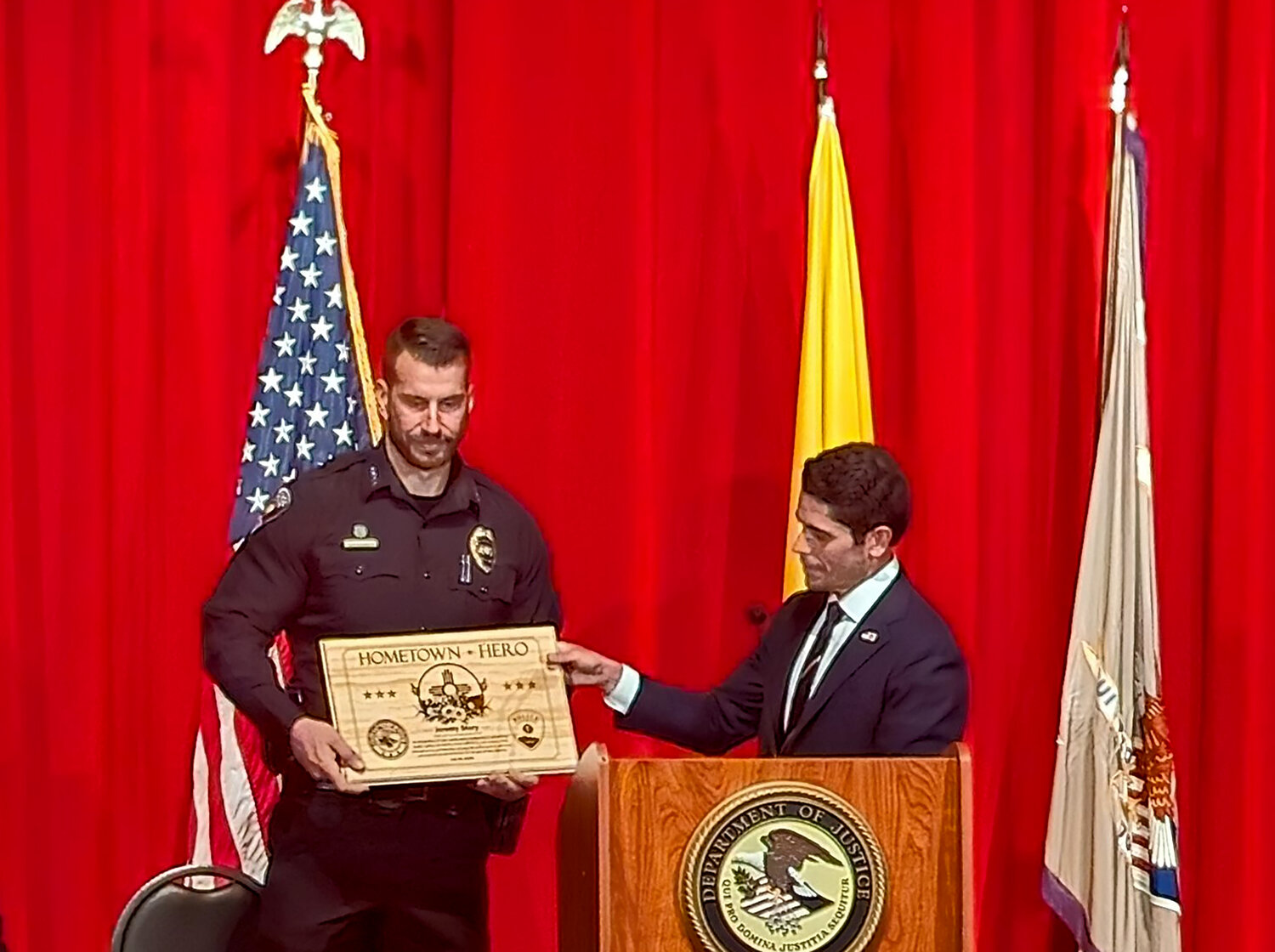


By the time Jeremy Story ever reached the podium, three people had already spent nearly 20 minutes explaining why he deserved to be there.
Las Cruces Mayor Eric Enriquez spoke first. He called the Las Cruces police chief a leader whose impact "cannot be measured merely in years of service, but in the profound legacy of integrity and safety he has built." He described a chief who had never asked an officer to do something he wasn't willing to do himself, someone whose "boots-on-the-ground mentality" had created a culture of mutual respect throughout the Las Cruces Police Department.
State Sen. Crystal Brantley followed.
"The American hero is becoming an endangered species," she said. Not because heroes no longer exist, she explained, but because fewer people choose lives built around sacrifice, willing to give up nights, weekends, holidays and family time because protecting complete strangers matters more than personal success.
"Across political aisles, he is respected," Brantley said, "because people know that his motivation has never been politics. It's people."
Then U.S. Attorney Ryan Ellison stepped to the microphone on behalf of the Department of Justice. When officials in Washington asked him to select New Mexico's recipient of the Freedom 250 Hometown Hero Award, he said the decision took "about two seconds."
Story saw it differently.
"I am incredibly honored to receive this recognition," he began. "But I also feel that it's undeserved."
It wasn't false modesty. Recognition itself wasn't what made him uneasy. It was taking credit.
"When I hang up this badge," he said, "I will feel a sense of accomplishment knowing that I poured my heart and soul into this position, this department and our city. I have to recognize that it's by God's providence and His goodwill that I serve as chief at all."
Then he turned toward the third row, where his wife, Jennifer, sat. For the first time all morning, his voice faltered.
"I reflect often on just how inconceivable it would be to try to do this job without the love and support of my wife," Story said. "We've had many moments of celebration, and we've had more than one moment of shared tears. Everything that I've accomplished of value has been because of her."
Then he widened the circle.
"I come up with an idea," he said. "Which is the easy part." Someone else, he explained, almost always does the hard work. "It takes collaboration to accomplish anything. All the problems we've solved have been because of that collaboration. Everything that we overcome in the future will be because of that collaboration."
As a boy growing up in Phoenix, and later after his family moved to Las Cruces when he was 12, Story devoured history books. The Revolutionary War. World War I. World War II. The history of the Marine Corps. He wasn't simply fascinated by battles. He was fascinated by leadership.
"I've always been drawn to it," he said. "It was just something in me."
He skipped eighth grade, graduated from Mayfield High School shortly after turning 17 and enlisted in the Marine Corps that same month.
His future seemed obvious. He would attend New Mexico State University, complete Officer Candidate School and spend a career wearing the uniform of the United States Marine Corps. Instead, the first major leadership decision of his adult life had nothing to do with command. It had everything to do with listening.
Jennifer has been part of Jeremy Story's story almost from the beginning.
They met as teenagers and dated through high school. They married when he was 19. By then, the future seemed settled. Then Iraq intervened.
Their first child, a daughter, was born while Story was deployed overseas. Jennifer experienced complications during childbirth, and by the time he returned home, his daughter was already five months old. His wife had reached a conclusion.
"She said, 'You're enlisted. When you finish this, I don't want to do the officer thing,'" Story recalled. "I said, 'Okay. Then I'll get out of the Marine Corps and I'll be a cop.'"
That decision redirected everything that followed. Instead of serving around the world, he would spend the next two decades serving the community where he grew up. The mission changed. The calling never did.
If there is one thread running through Story's life, it is that service has almost always outweighed ambition. He talks about developing people, about giving officers room to improve by sharing what he's learned. Over nearly 20 years, those lessons came from almost every assignment the department could offer.
He worked patrol, became a K-9 handler, served in street crimes and led the gang unit. He worked alongside virtually every federal law enforcement agency during complex investigations. Later came supervision, command staff and executive leadership.
The gang unit, he said, taught him the most.
"We did a little bit of everything," he said. "We worked with every federal agency you can imagine. We did all kinds of different cases. We did super petty stuff that nobody wanted to do all the way to big cases that are glamorous. I learned a ton from that position about policing in general."
One lesson from his Marine Corps years became the foundation for how he viewed leadership. The Marines, he said, emphasize two priorities above all else: mission accomplishment and troop welfare. Most organizations naturally focus on the first. Story has spent much of his career thinking about the second.
"I learned early on that if you take care of the troops, most of the time the mission will take care of itself," he said. "There are moments when those priorities compete. But if you take care of the troops any chance you can, "they're more understanding when there's those times where they conflict. I've carried that with me in everything I've done."
Ask Story what makes a good officer, and he doesn't begin with firearms proficiency or physical conditioning.
"The easy answer is emotional intelligence," he said. "If there's one thing I say is critical ... it's high emotional intelligence."
Then he offers a definition that has become something of a personal philosophy.
"A good man is not a harmless man," he said. "A good man is a dangerous man with self-control, compassion and discipline."
"That's the ideal officer," Story said. "Someone who has both sides of that coin."
His expectation is simple, even if living up to it is not.
"We should be the calm voice," he said. "We should be the professional in every interaction."
That standard, he believes, is met far more often than the public realizes. Story points to a recent assessment by the National Policing Institute that reviewed more than 9,000 hours of Las Cruces Police Department body-camera footage. According to the study, officers displayed professionalism, respect and empathy in more than 97 percent of their interactions with the public.
"That's what I see time and time again," Story said. "I wish I could show the public that in a better way."
It is perhaps no coincidence that transparency has become one of the hallmarks of his administration. Ellison praised Story for leading the department into "a new era of public engagement and transparency," noting his willingness to communicate directly with residents through town halls, social media and regular updates following critical incidents.
"He puts himself out into our community," Ellison said. "He's also leaned in on identifying bad policies ... and advocating for change."
That visibility has come at a personal cost.
Story admits he has never been especially good at leaving the job behind.
"I don't do that well," he said when asked about work-life balance. "The reality is ... it drains me mentally and it affects my family. I preach it to the officers. I don't always model it as best as I should."
He describes himself as someone who functions better under pressure than in calm.
"There is a negative aspect to it, too," he admitted.
Early in his career, overtime meant missing moments he wishes he could have shared with his children.
"I worked a lot of overtime early on," he said. "I was gone a lot. My wife was very gracious. My kids were very gracious. Because I missed a lot of things that I wish I wouldn't have just because of the job."
Those sacrifices explain why, standing at the podium, Jennifer was the first person he thanked after acknowledging God. The emotion in that moment wasn't rehearsed or performative. It was the realization that no recognition bearing his name could exist without the people who had quietly carried its weight beside him.
Ask Story about the hardest day of his career, though, and he doesn't mention Young Park. His answer comes immediately.
"The day we lost Officer Hernandez. There have been many difficult days," he said. "That's by far the worst."
Brantley had witnessed another side of that burden.
She recalled the days following the Young Park shooting, describing them as among the darkest the city had experienced. In those hours, she said, Story and his department responded "with a level of professionalism, compassion and composure that helped this city begin to heal."
Las Cruces was watching. "So was the entire state of New Mexico," she said.
The victories, on the other hand, are harder for him to remember. He tends to move on quickly, focusing instead on the work still left to do.
The good days often arrive quietly — accountability finally achieved after years of pursuing a repeat offender, another victim protected, another officer making a difference few people will ever see.
That perspective surfaced again as he closed his acceptance speech. The history buff who had spent a lifetime reading about the Revolutionary War reminded the audience that Americans celebrate July 4, 1776, but freedom did not arrive that day. It took eight difficult years.
The lesson, he said, extends well beyond history. Communities are not strengthened overnight. Crime is not reduced overnight. Trust is not rebuilt overnight. It takes perseverance and collaboration. It takes people willing to continue showing up long after the applause fades.
"When I look back over the past three years," Story said, "I see so many examples of that perseverance and collaboration that led to success. Because of that, I have more confidence than ever that in three years, Las Cruces will be a better place than it is now."
The Freedom 250 Hometown Hero Award will forever list a single recipient.
But for anyone who listened carefully that morning, the award never really belonged to one man.
The mayor saw it in a leader who never asked more of others than he asked of himself. A state senator saw it in someone whose motivation had never been politics, but people. A U.S. attorney saw it in a chief who had guided a department through measurable progress while never losing sight of its purpose.
Jeremy Story saw something else entirely. A lifetime of people who had invested in him, challenged him, believed in him, sacrificed for him and served beside him. Perhaps that's why he never tried to redefine what it means to be a hometown hero.
He simply redefined who gets to share the title.


