Tuesday, October 27, 2026
Partly Cloudy, 53°Wind: mph,


Welcome to our new web site!
To give our readers a chance to experience all that our new website has to offer, we have made all content freely avaiable, through October 1, 2018.
During this time, print and digital subscribers will not need to log in to view our stories or e-editions.


Every morning, they come hoping their number will be called. Some arrive on foot. Some have spent the night at Camp Hope. Others are staying with friends, sleeping in cars or hanging on to housing by a thread. They gather in a warehouse at Mesilla Valley Community of Hope, add their names to a list and wait while a lottery determines who will work that day.
Twenty people will climb into vans and spend the next several hours cleaning litter, clearing brush and maintaining city property through the Mano y Mano day labor program. Those not selected today will try again tomorrow. It's a scene that doesn't fit neatly into many people's assumptions about homelessness.
"When people tell me how much people don't want to work, that's just not true," said Nicole Martinez, executive director of Mesilla Valley Community of Hope. "They come every day and sign up for this until they get it."
The image of dozens of people competing for the opportunity to spend a day working outdoors for minimum wage says something Martinez believes is often missing from public conversations about homelessness. Most people she encounters are not looking for a handout. They are looking for a chance. A chance to earn money. A chance to find stable housing. A chance to regain some measure of control over lives that, for a variety of reasons, have unraveled.
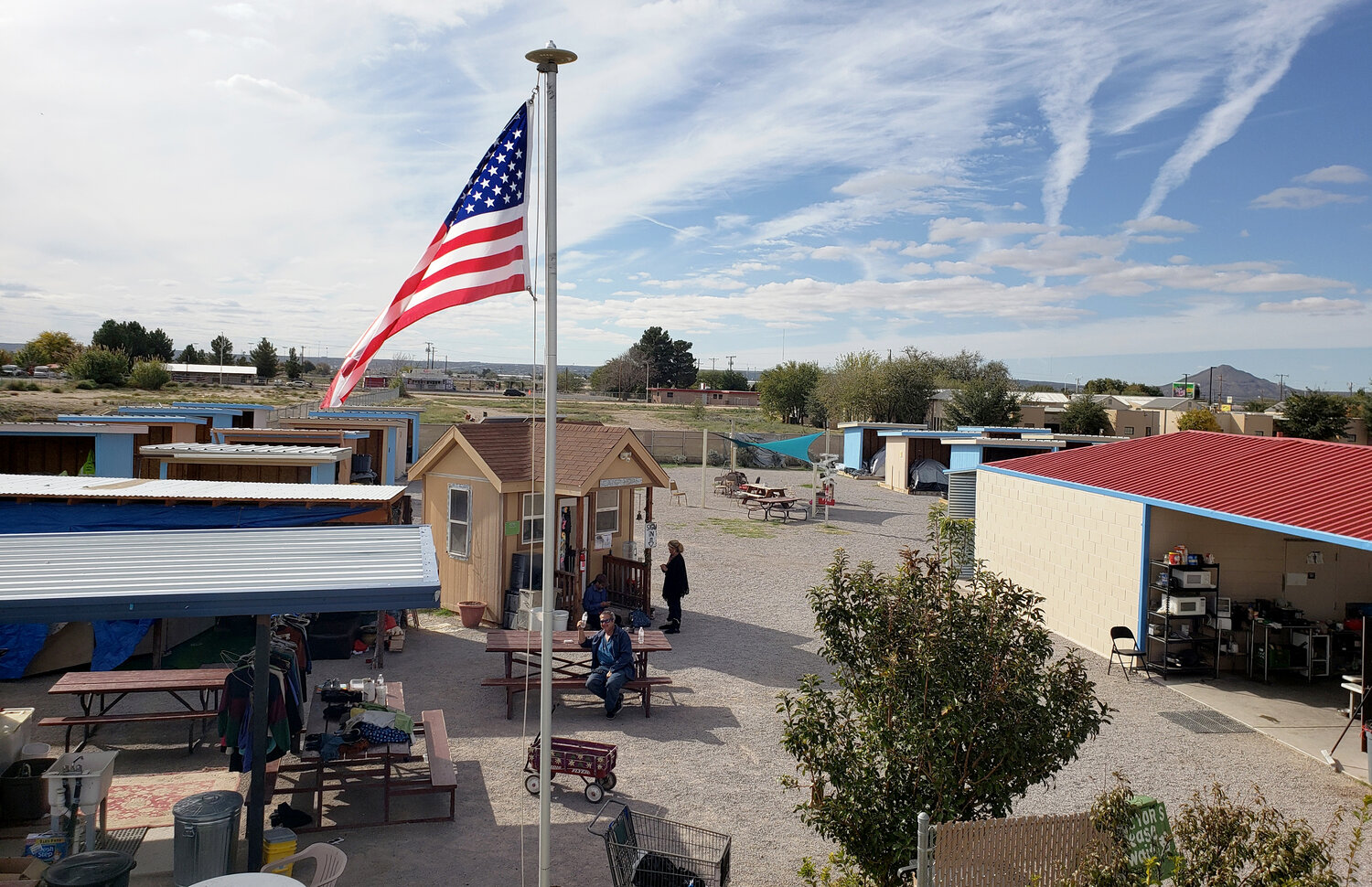
That same theme surfaces a few steps away at Camp Hope, the sanctioned encampment Community of Hope developed in partnership with the City of Las Cruces.
To many residents, a camp of tents might sound like an act of charity. Spend time there, however, and a different picture emerges. Camp Hope's residents help run the community themselves.
They staff what is known as the Safety Shack. They monitor who enters the camp after hours. They help distribute supplies and accept donations. They attend regular meetings where concerns are discussed, solutions proposed and rules adjusted. They enforce standards that prohibit drugs, alcohol and violence. They are not passive recipients of services. They are participants in the operation of the community they call home.
"The idea is that they really enforce everything," Camp Hope director Lizz Coyle said. "They are the ones who make sure that all the rules get followed."
The model grew out of a conversation Community of Hope had with people experiencing homelessness more than a decade ago. Faced with growing concerns about violence against homeless residents and people sleeping on the organization's campus, leaders asked what might work better. The answer came from the people living the experience.
"What if we try a tent city?" they suggested. "We'll help run it."
The result has endured for nearly 15 years. For Coyle, Camp Hope functions less as a destination than as a place where people can pause long enough to move forward.
Some are waiting for disability determinations. Some are working through health challenges. Some are trying to replace identification documents, reconnect with benefits or save enough money to secure housing. Many have pets they refuse to abandon. Nearly all are carrying more complicated stories than the stereotypes often attached to homelessness. The waiting list routinely exceeds 100 people.
"We try to make it just a place to be while you're achieving whatever specific goal you have in mind," Coyle said.
That complexity is something Community of Hope founder Nancy McMillan has watched the community slowly come to understand.
McMillan helped launch the organization in the early 1990s after conversations among local churches, service agencies and community leaders about how best to address poverty and homelessness in Las Cruces. The idea was deceptively simple: place services in one location so that people seeking help would not have to navigate a maze of disconnected organizations.
More than three decades later, she still believes one of the organization's greatest accomplishments is changing perceptions.
The stories featured through Tents to Rents, Community of Hope's annual fundraising campaign, regularly surprise people. The individuals highlighted are often articulate, educated, deeply faithful and remarkably resilient. Some have college degrees. Some have worked successful careers. Some experienced illness, family crises, rising housing costs or a string of setbacks that compounded faster than they could recover.
"They're like you and me," McMillan said. "Some of it's their fault and some of it's not. They're human beings."
That reality is one Martinez sees every day. She points to rising rents, stagnant wages and a shrinking supply of affordable housing as major drivers of homelessness in Southern New Mexico. Many of the people seeking help are not newcomers arriving from elsewhere. They are local residents who simply reached a point where housing became unattainable.
Once someone loses housing, she said, every problem becomes harder. Maintaining employment becomes harder. Managing health conditions becomes harder. Accessing benefits becomes harder. Something as basic as a safe night's sleep becomes a luxury.
Asked what people do first after finally receiving housing, Martinez doesn't cite moving trucks or celebrations. Again and again, she hears the same answer. They lock the door. They make the bed. And they sleep.
For people who have spent months or years wondering whether they will be safe through the night, that simple act can feel life-changing.
That is ultimately the destination Community of Hope is pursuing, whether through housing programs, case management, Camp Hope or Mano y Mano. The tents are temporary. The goal has never been to keep people in them, which is why Tents to Rents exists.
The annual campaign helps fund Camp Hope, a program that receives little direct operational funding despite serving as a crucial bridge for dozens of people each year. But it also serves another purpose. Through stories, photos and personal testimony, it invites the broader community to look beyond the tent and see the person inside.
In a city where conversations about homelessness can quickly become polarized, Community of Hope continues to make a different argument: that most people are not defined by the worst chapter of their lives, and that sometimes the most important thing a community can offer is not rescue, but opportunity.
Every morning, the line forming for Mano y Mano offers a reminder. The people standing there are not waiting for someone to do everything for them. They are waiting for the chance to do something for themselves.


