Tuesday, October 27, 2026
Partly Cloudy, 53°Wind: mph,


Welcome to our new web site!
To give our readers a chance to experience all that our new website has to offer, we have made all content freely avaiable, through October 1, 2018.
During this time, print and digital subscribers will not need to log in to view our stories or e-editions.
There was never anything wrong with Jorge Martinez-Rios' plan. He had earned admission to the prestigious Universidad Iberoamericana in Mexico. His classes were scheduled. His scholarship was secured. His parents were proud. Law school was waiting.
He asked for one month. Before beginning his legal studies, Martinez-Rios wanted to attend a summer music festival in Morelia. It was a chance to immerse himself in music before settling into a different career, one he assumed would define the rest of his life.
Instead, it changed everything.
"At the end of the first day," he said, "after having piano lessons, choir, history, ear training and theory, I knew that's what I wanted to do for the rest of my life."
He returned home only long enough to gather his belongings. Law school was over before it began. He withdrew from his classes, packed his clothes and headed back to Morelia, where he would spend the next seven years studying music.
"I don't think we choose music," he said. "Music chooses us."
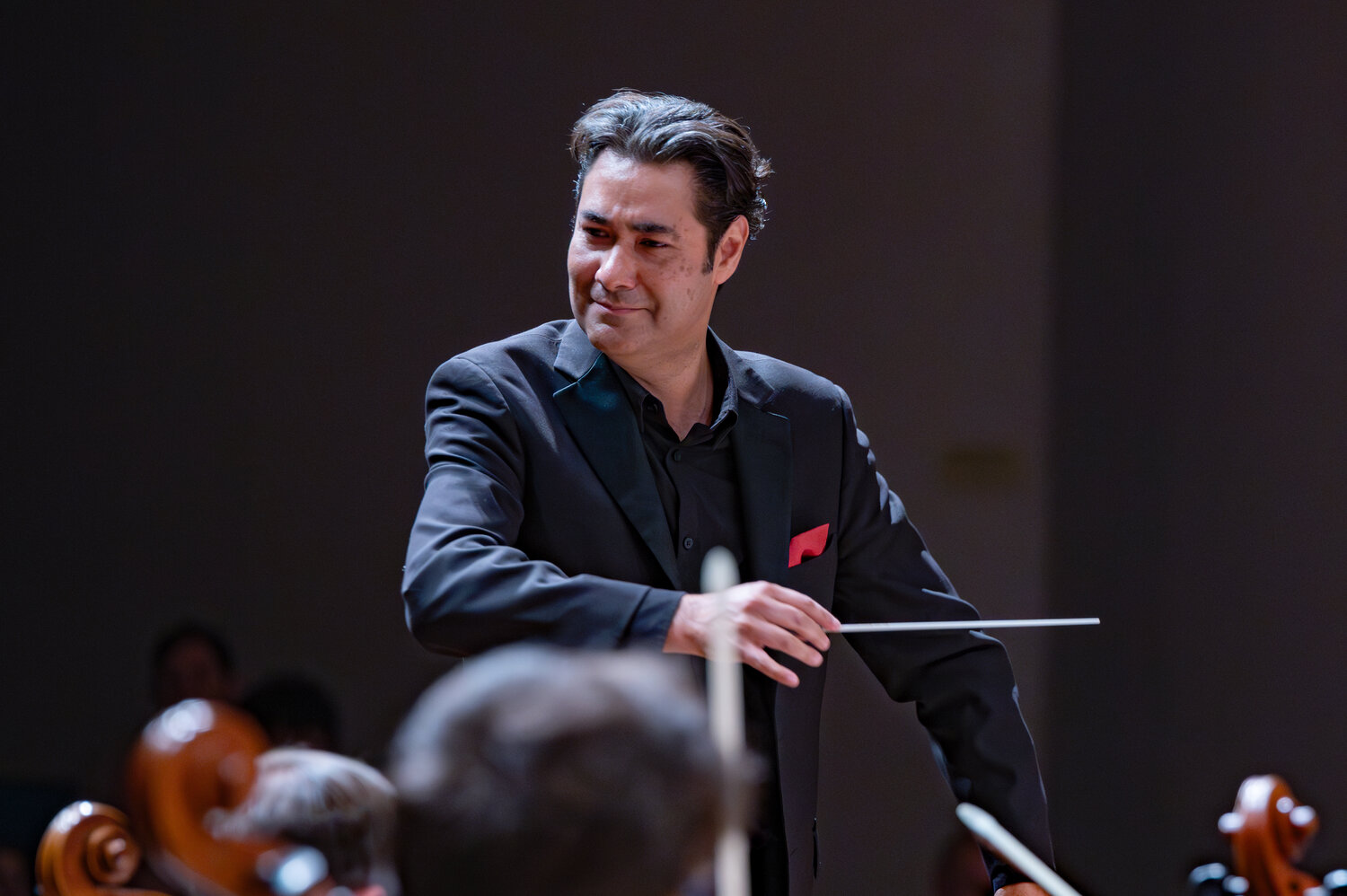
That belief explains nearly everything about the man who today serves as music director and principal conductor of the Las Cruces Symphony Orchestra.
Martinez-Rios' relationship with music began long before he ever stood in front of an orchestra. Growing up in Torreón, Mexico, he remembers family Sundays when relatives gathered to play together. His father sang. Uncles played electric guitar, bass, keyboards and drums. While other children ran through the house, Martinez-Rios found himself drawn toward the music.
"I remember hearing those songs on the radio afterward," he said. "Even when I was four or five years old, I knew who was going to make mistakes and why. I knew my dad wasn't going to come in at the right place. I started to learn entrances, good ones and bad ones."
Soon came piano lessons with a neighborhood teacher who recognized his dedication. While she worked with other students, she would leave him alone with one of the house's many pianos, trusting him to practice for long stretches before returning to coach him. He loved every minute of it.
Eventually piano led to choirs, guitar and, later, the viola. At the conservatory in Morelia, he discovered the instrument almost by accident. Students were encouraged to study a secondary instrument. Violin didn't feel right. Cello seemed too cumbersome. The viola fit.
It would eventually become his principal instrument, leading to graduate studies at Western Michigan University and Kent State University, professional performing opportunities and, ultimately, a faculty position at New Mexico State University in 2009, where he teaches viola along with a variety of music courses ranging from theory and ear training to chamber music and orchestra. Along the way he also discovered conducting, a discipline that combined everything he loved about music. Today, teaching and conducting are inseparable parts of his life.
"They're kind of equal to me," he said. "To realize things click for a student and all of a sudden they're performing naturally, their technique and musicality are flowing organically, that's priceless."
He understands how long that journey can be because he has lived it himself.
"It takes many years to become a good performer," he said. "Once you're a good performer, it takes another amount of years to be a good teacher. Once you have both, it's so nice to see that you're building strong players that eventually become music educators or performers."
Ironically, Las Cruces first entered his life not because of a job interview but because of a concert invitation. While performing professionally with a string quartet, Martinez-Rios received a call from Barbara Toth, who had founded Mesilla Valley Musical Arts.
The quartet came to Las Cruces to perform at San Albino Church and present a master class at New Mexico State University. During that visit, then-department head Ken Van Winkle encouraged the musicians to apply when faculty positions opened. They did.
Martinez-Rios joined the NMSU faculty in 2009 and spent the next decade as principal violist with the Las Cruces Symphony Orchestra while continuing to develop as a conductor. He credits Dr. Marianna Gabbi, who invited him to lead the New Horizons Symphony, and longtime Las Cruces Symphony music director Lonnie Klein, who mentored him, offered advice and gradually entrusted him with opportunities to conduct the orchestra.
Those experiences prepared him for the opportunity that followed Klein's retirement. Today, however, Martinez-Rios sees his role as extending well beyond the podium.
As the symphony emerged from the financial challenges that followed the pandemic, he found himself spending as much time meeting with donors and community leaders as studying scores. He helped raise the funds needed to finish last season and has continued that effort while helping build support for the orchestra's future.
He speaks about fundraising with the same enthusiasm he brings to rehearsals because, to him, both are part of the same mission: making sure live orchestral music continues to flourish in southern New Mexico.
That philosophy also shapes the music audiences hear. His first full season reflects a balance between beloved masterworks and new discoveries. He asks orchestra members what they want to perform. He chooses pieces he has dreamed of conducting since childhood. Most importantly, he thinks about the audience.
"I want the audience to grow with the masterworks that we all know and that people love," he said. "From there my idea is to slowly start incorporating music that has meaning, that has a message."
For Martinez-Rios, every concert is another chance to invite listeners into the same lifelong relationship with music that began in a house full of family musicians in Torreón.
After all these years, he still believes the decision wasn't really his. Music had already made it for him.