Sunday, October 4, 2026
Clear, 75°Wind: mph,


Welcome to our new web site!
To give our readers a chance to experience all that our new website has to offer, we have made all content freely avaiable, through October 1, 2018.
During this time, print and digital subscribers will not need to log in to view our stories or e-editions.
This story by Liberty Darr and Patrick Bilow was first published in the News & Citizen on Sept. 17, 2026.
One in three Vermonters will heat their homes with wood this winter, but as the cost and difficulty of sourcing wood increases for some, a handful of local organizations are providing free cords to those in need.
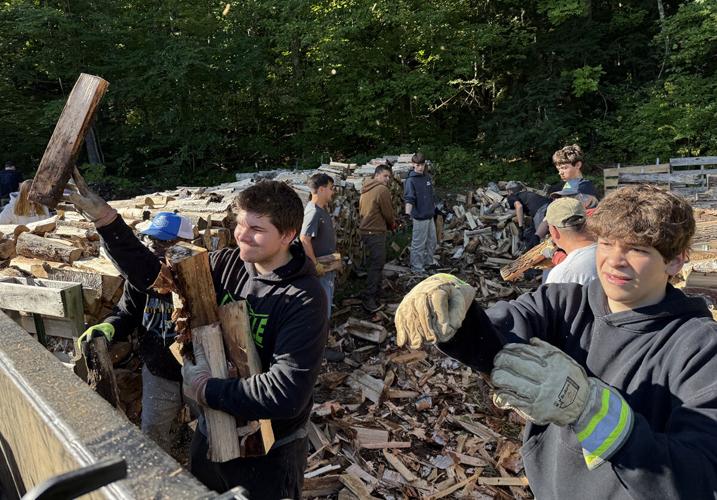
Recently volunteers donned safety gloves and earmuffs for an annual firewood workday in Morristown with United Way of Lamoille County. Wood splitters of various shapes and sizes fired on all cylinders as volunteers chucked chunks of wood into trucks for home deliveries.
The United Way’s firewood program is one of multiple wood banks in the Lamoille County area that provide free firewood to local seniors, veterans and income-eligible families to help keep their homes warm throughout the winter.
According to the most recent statistics from the Vermont Department of Forests, Parks and Recreation, as of 2019, just over a third of Vermont households use cordwood as a heating source — a statistic that is largely unchanged from reported usage in the 2014-2015 heating season and similar to usage in the 1990s.
Meanwhile, nearly two-thirds of Vermont households using cordwood rely on it as their primary source of heat, while just over one-third use it for supplemental heat, according to the department’s 2019 Residential Fuel Assessment.
The survey also indicates that Vermont households burned more than 400,000 estimated cords of wood during the 2018-2019 heating season — 18% higher than the estimated total number burned during the 2014-2015 season and higher than any previously reported estimate since 1986.
As reliance on wood as a heat source increased marginally in Vermont as of 2019, the price of a cord skyrocketed to around $500, according to those familiar with the industry. Meanwhile, recent increases in oil prices anecdotally pushed some Vermonters back to burning wood.
While financial assistance is often provided for oil burners, less is available for wood burners. According to information from the state’s Department for Children and Families from 2023, just under 2,000 households that heat with wood and pellets were issued benefits.
That’s where wood banks are stepping up.
Not only can burning wood be cost intensive, but it’s also labor intensive, creating a relatively substantial barrier to the heat source, especially for older demographics.
“If you’re elderly but you have a wood stove and can’t afford to replace it, then you’re going to end up needing firewood, and it can be really cumbersome or impossible for folks to process their own wood,” said Clarissa French, executive director of United Way of Lamoille County.
In any given year, the organization gives away between 40 and 65 cords, based on demand, which some providers say is increasing. Most of the wood is harvested on state land and donated by the state of Vermont through its Wood Warms program.
Stephanie Ferro, a United Way board member, and her husband, Bryan, operate their own wood bank in Stowe called Vermont Warm Hearts, which he launched as a high school student in Woodstock.
Between Lamoille and Windsor counties, the organization delivered emergency wood to nearly 20 families last year.
They are often contacted during emergency situations when a family is almost out of wood in the dead of winter. The small, family-run operation — their daughter Sophia is involved — tries to fulfill those deliveries within 24 hours.
“The demand is going up,” Stephanie Ferro said, adding that there is a substantial group of people in need that are just above the income threshold the state utilizes for determining eligibility for fuel assistance.
They are often left to choose between feeding their families or heating their homes, she said.
Another wood provider, Wood4Good, is expanding its influence in Lamoille County. Since launching in 2019, the nonprofit has donated and delivered approximately 50 cords of wood each year to towns across Vermont.
Eric Axelrod started Wood4Good with his son after a pile of firewood in their yard had grown too large to continue storing. They gave a few cords away and have been chasing that feeling ever since.
“We gave that wood away, and the family we gave it to said to us, ‘This is the first winter we’re going to be OK,’” Axelrod said. “Then we found another family that was burning furniture to keep their home warm.”
After years of increased reliance on its service, Wood4Good recently expanded its influence in Lamoille County. The nonprofit processes firewood with automated splitters in Jericho but has storage facilities throughout the state, including in Johnson.
The Wolcott Selectboard is also mulling whether to allow Wood4Good to clear trees in the town’s newly established forest as it expands municipal wastewater services and expands trail networks on the land.
Several towns in Chittenden County, including Hinesburg and Shelburne, allocate funds for the nonprofit. No towns in Lamoille County have yet to follow suit.
As winter sets in and households scramble for firewood, Axelrod agreed with other wood banks that need is increasing and recently spiked. Just this year, he received 50 new applications for firewood next winter.
Recently he also received a letter from an elderly customer who said she and her dog almost froze to death last winter huddling under an electric blanket.
“That’s the story of a lot of Vermont. That story is very, very real,” Axelrod said.
These three wood banks — United Way, Vermont Warm Hearts and Wood4Good — do not operate in silos.
To create the greatest impact, French from United Way said, local wood banks are trying to network more and regularly attend collaborative meetings with state officials.
“There’s not enough wood bank activity in the state, but there are little wood banks trying to make an impact all over the place,” she said.
For example, Stephanie Ferro does a lot of coordinating between her family’s organization and United Way. If the call is one that doesn’t fit the bill for Vermont Warm Hearts, they may relay the request to another organization. Her and her husband’s organization provides emergency support, whereas United Way doesn’t typically.
“When we moved here, and I heard what United Way was doing, I said to my husband, ‘I want to get involved and let’s see if we can work together so that we can share resources, share brain power and share energy,’ and I think it’s definitely working for us,” she said.
Read the story on VTDigger here: Wood banks prep for long winter months.
Courtesy of VT Digger


